Showing posts with label travel. Show all posts

Monday, May 24, 2010

JO GO TO SPAIN - Part 4.3 - Laureano Serre's vineyards


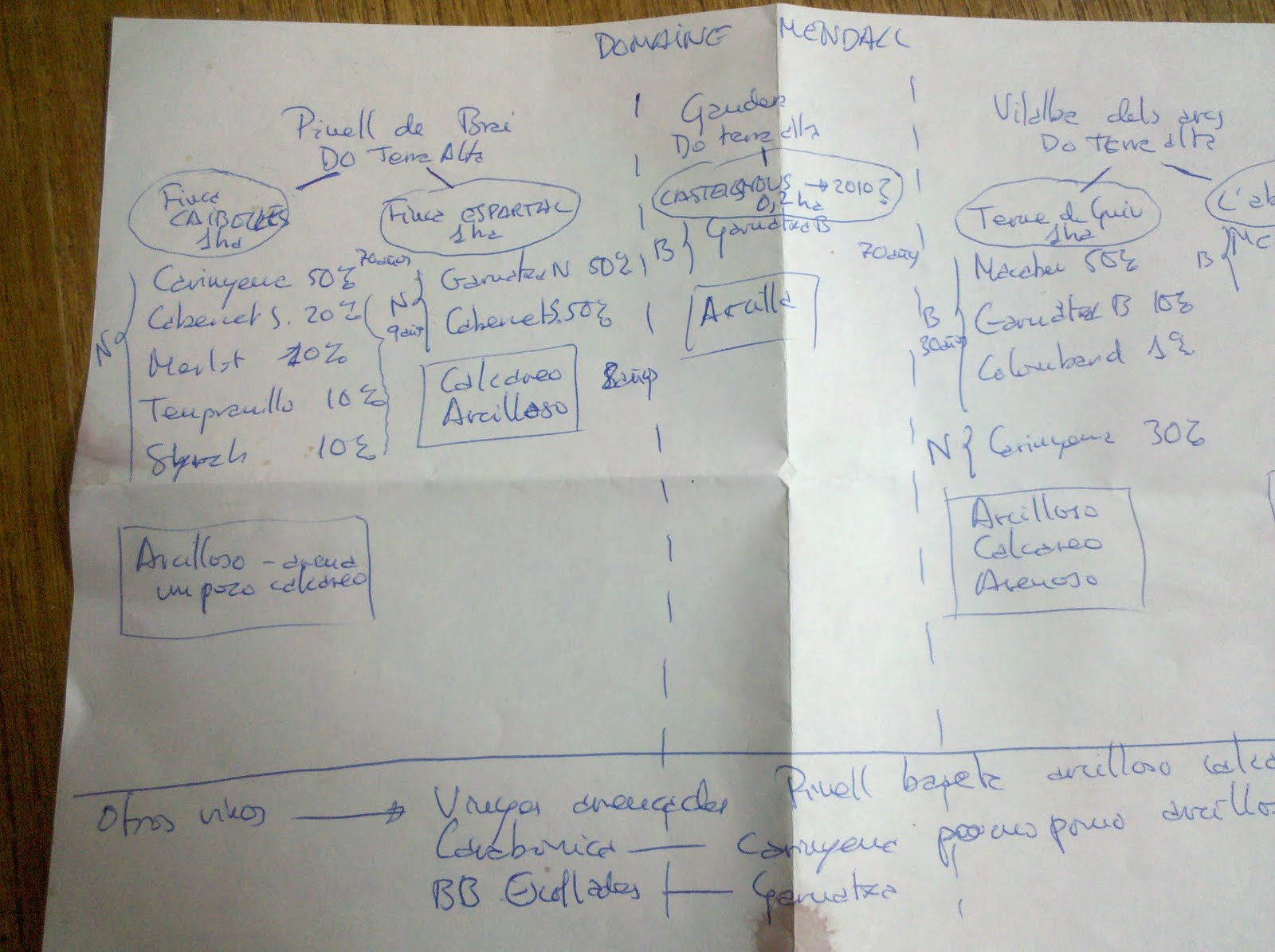
One last thing about the visit casa Laureano Serres. During the last post I did not get into his various vineyards for a reason. If you look at the sketch above, it's all spelled out for you. His friend Joan and I were joking and busting his chops a bit when he pulled this out, "Que profesional!" But the truth is, though, this sketch is far more interesting and to the point, far more indicative of someone who is involved in his winemaking on all levels, than any glossy catalogue someone could pay to produce. Better for the environment, as well.

JOE GO TO SPAIN - Part 4.2 - BRUTAL Y HEAVY, TIO


Laureano Serres, Joan Ramon Escoda and I tasted/drank 25 wines. No we did not empty 25 bottles. Yes, we did drink on occasion and did not spit every time we tasted.

Tasting a new wine (well, an interesting and tasty new wine) can be exciting. A producer line-up of largely unfamiliar wines is both exciting and a thorough education - not to mention a terrific introduction to a vineyard(s), to a certain facet of a grape varietal, perhaps to a winemaking philosophy, and of course to the winemaker overseeing the whole process. That fateful Saturday evening in Pinell de Brai served as an introduction to Laureano Serre's Mendall winery, to Joan Ramon Escoda's Celler Escoda Sanahuja and on the whole to the Spanish natural wine community.

Though I wish I had a transcript of the tasting, which was conducted primarily in castellano, with some interjections in catalan and even a smattering of english, all I have is my notes, which may be lacking in detail or accuracy; I encourage anyone who is more familiar with these wines than I am to comment and share your thoughts or feel free to correct any errors in factual information here. Sometimes, when a whole new world is introduced to you in short order, impressions are not fully recorded, facts may not always be 100% straight.

2008 Mendall Vinyes Arrancades

Peculiar wine from unusual circumstances. Mildew was rampant in Laureano's prized 100 year old macabeu vineyard. He chose not to treat it. As a result, the maturation process lasted a long time. Many leaves fell off. Finally, by late October, the grapes were picked and produced this orange-ish colored wine. Intense, mineral, funky, natty aromas and an exotic flavor profile that suggest an orange wine though there was no extended skin maceration whatsoever. A unique wine for sure.

2007 Mendall Vinyes Arrancades

Has 10% garnatxa blanca. This was done in a flor style. As Laureano did not top off his tanks, a flor somehow developed and he went with it. Just like with the mildew in the aforementioned Arrancades (sensing a theme here, yet?) Delicious wine, slightly salty and like a sous voile savagnin with more fruitiness due to the different varietal and mediterranean climate.

2006 Mendall Vinyes Arrencades

This one has a little garnatxa blanca as well as colombard. Though less expressive on the nose, it has more acid on the palate. Less mouth coating and more linear. Good.

2005 Mendall Garnatxa Blanca

If I recall correctly this wine was opened nearly a week ago? Laureano said that initially it showed very oxidatively and then dramatically opened and freshened up. There was indeed great acidity and freshness on this wine.

2005 Mendall 5 anys i 1 dia

This wine was in stainless steel tanks for five years. Untouched. 11 mg total sulphur, 11.2% alcohol, garnatxa and macabeu. Winemaking on the fringe? Yes, perhaps, but a whole lot more interesting than a bottle of over-sulphured viura, over yeasted albariño, or fruity fruity verdejo. I hope the Spain nay sayers are paying attention....

2009 Mendall L'Abeurador

Fresh fruit on the nose. Compared to the last wine this is rather straight ahead and clean. Intense fruit, a bit of hazlenut on the finish. 2 dias maceration on skins here. This may be the easiest to like of all the whites we were to taste.

2008 Mendall Terme de Guia

Macabeu, garnatxa blanca, colombard. Raisins and orchard fresh apples on the nose. Fresher flavors on the palate than the nose.

2009 Mendall Terme de Guia (1.5l)

A colder fermentation was used on this bottling. Tasty, less intense character with more acid.

2008 Mendall L'Abeurador

Back to this bottling, the 08 vintage. A warmer fermentation was employed. This tasted fresh and bright.

A wine from Laureano's friend and fellow natural winemaker Joan Ramon Escudo...

2007 Celler Escoda Sanahuja Els Bassots Conca de Barbera

Chenin Blanc. One of those wines that you can smell will assault your gums and teeth with acid (in a good way). A bit reductive, but mineral as hell and delicious. Joan described this best by calling it "un gin tonic natural." Agreed.

2009 Mendall Cara Bonica

A play on the word spanish word for carbonic maceration. Cute label of a 'cara bonica' drawn by Laureano's daughter. Rich, sweet, fresh fruit. Warm climate generosity of fruit expression, but with freshness. This is cab, merlot and cariñena with a one week carbonic maceration.

2007 Mendall Cara Bonica

A bit less fresh. Still pleasant to drink, but comparably heavy and missing the delicious primary quality of the '09.

2009 Mendall Finca Espartal

This is primarily garnatxa with a bit of cariñena, all fermented with carbonic maceration. Red fruits, skins and pits aromas of berries and plums are all here. My tasting notes after this simply read: "vino de amor."

2008 Mendall La Terme de Guia

Notes very skimpy. Here they are: "Carignan. 14%. Acid."

2007 Celler Escoda Sanahuja "La Llopetra" Conca de Barbera

PN from calcareous soils. One year in barrica (2-3 years average age). Dark fruits on the nose, a bit reductive similar to Joan's white. Acid and tart cherry/plum fruit stand out on the palate. This wine is completely sans soufre (8mg/l total sulphites). Once again, I am taken aback both by the incredible acidity and austerity of this wine, as well as by how well it takes to oak aging. Similar to Joan's chenin blanc, this is serious natural wine, well made and not for casual sipping.

2006 Naranjuez Pinot Negra Vino de Mesa

12.5% pinot noir from Granada - what? 950 meters above sea level, these grapes were harvested on September 18th. The character is intense, sauvage, and serious, with good acid. Not cheap at around $45, but interesting for sure.

2006 Celler Escoda Sanahuja Les Paradetes Conca de Barbera

50% garnacha, 25% cariñena, 25% sumoll (100 yr old). 12-13 months in oak, 25% new. Juicy, fresh berry with good acid.

2009 Vamos? Vamos!

Only 190 magnums of this collabo between Joan and Laureano were bottled. Egged on by Thierry Puzelat, the two joined forces by combining their cariñena (Laureano) with merlot and cab franc (Joan) in a fresh, delicious drink me now bottle. My TN reads, "Wow!" so it has to be good, right?

2009 Cariñena (component from Vamos? Vamos! blend)

This is the funky, berry part of the equation!

2005 Emidio Pepe Montepulciano

Closed, tough dark fruit. Sulphur, particularly notable in this natural set. I told Laureano not to open this but he just felt compelled (perhaps because he saw me eyeballing it earlier on?) It might have even been a magnum - I don't remember. Damn, infanticide....

2006 Barranco Oscuro "Rubaiyat"

Another one from Granada. Acid! Berry y muy brutal. Somehow this smelled sort of like a white wine (?) All syrah, I believe.

2004 Barranco Oscuro

No notes. I do remember this one being very tough to taste and get a read on.

Yes! "R" Blanc

Fun wine. Another flor style, dubbed yes for a one line email that importer José Pastor allegedly sent to Laureano regarding this wine: "Yes!"

2008 Mendall Mal de Sofre

This was opened a week ago. It was oxidized and showed a most unusual resemblance to Cynar, the Italian artichoke bitter. Laureano proceeded to tell me a story about Cynar in a Quentin Tarantino movie, I really do not remember more details than that.

And so ends this installment of the trip dialogue. If anyone has read through all of that nonsense and is still here then I must thank you for truly being a good sport. Tasting notes, at least those for public consumption, generally suck. That having been said, a tasting like this seemed best described in tasting note format.

Next up: The big, the boutique, the gravity fed, and the pumped/sterile filtered in Rioja.

Friday, May 14, 2010

LO NATURAL hits España


No time for part 4 to go up this week, it seems. But I really look forward to writing it, quite possibly more than any other post I have written to date. Let me explain why.

I drove through the Catalunyan countryside, passing through pueblo after pueblo, crossing the Ebro and finally meeting one Laureano Serres at his house and winery in El Pinell de Brai. What followed was something of an introduction to the small, but fervent group of vignerons in Spain who are a part of the growing natural wine community. By now, you know the deal: careful, passionate attention in the vineyards with minimal treatments; fermentation with native yeasts, minimal to no sulphur added, and nothing else added for that matter.

Shortly after arriving, one of Laureano's best friends, Joan Ramon Escoda, another vigneron making wines in the Conca de Barbera D.O. about 30 minutes to the north, stopped by. What followed was a very extensive tasting, discussion, and sharing of thoughts and ideas about wine the likes of which I had seldom experienced. It was a heavy experience (as it turns out, 'heavy' has been appropriated into the Spanish language, pronounced with a jota, so, 'jevi'). Anyway, as I heard about the development of this tight community of 8 vignerons geared more towards natural winemaking in Spain, I learned about how it came together, Thierry Puzelat's advisory role, and most importantly I sensed the excitement and passion of these guys. It was contagious, and maybe even planted another seed somewhere in my head that perhaps I need to be out there growing vines and making wine some day.

So, that having been said, the full report will be found in part four of JOE GO TO SPAIN next week. I look forward to sharing what is undoubtedly one of the most rewarding winery visits and tastings I have yet to experience.

Tuesday, May 11, 2010

JOE GO TO SPAIN: Part 2 - in Cava country at Raventos i Blanc


In Spain's most developed and wealthy region, Catalunya, Sant Sadurni d'Anoia has got to be one of its most prosperous towns. A short 30 minute drive from Barcelona, the region of Alt Penedes and the village of Sant Sadurni are the home base of Cava production. It is also a popular destination for Spaniards and foreigners alike for a taste of wine tourism close to the big city; what Napa Valley is to San Francisco, Penedes is to Barcelona.

Cava is big business. Ever see a black frosted glass bottle of Freixenet at any celebratory reception you have attended? A gold label bottle of Cristalino in your local corner store? A selection of cava by the glass at any number of restaurants you have visited? In other words, much like lemonade, cava was a popular drink and it still is (thank you, Guru). There is no shortage of inexpensive juice being fermented and re-fermented in bottle, to be packaged, marketed and sold by any number of larger companies and co-operatives. Competition is fierce, particularly in the ever popular $10 and under segment. Some wineries prefer to not enter into that game, opting instead to make a better quality range of wines which they can sell more based on the quality of the wine and unique story of the winery.

Raventos i Blanc posseses a unique story as well as quality wine, produced from their own organically grown grapes. I will not go into an extended history of the Raventos family, which is tied into that of the Codorniu family, producers of one of the world's mega brands in cava. If you want such a history, I would go to Catavino for the full account. The short version is that, in 1986 Josep Maria Raventos i Blanc and his son Manuel, after owning the original Codornium vineyard holdings and selling off the fruit, created a winery specializing in estate grown and bottled cavas. In fact, the Raventos winery directly faces that of Codorniu across the street.


Josep Maria Raventos i Blanc, the son of current president Manuel Raventos, and grandson of the winery's founder, also Josep Maria, is relaxed and welcoming. Gesturing towards the handsome offices and interior of the visitor center, he says "My father was in to all of this - it is beautiful and I understand why he wanted this, but what I would like to do now is invest even more in the vineyards." We hop in his older Land Rover and tour the property, and it does become apparent that Josep is truly interested in viticulture, continuing to work to understand the unique quality of his family's vineyard holdings and the indigenous vines which compose the cava blend: macabeo (viura elsewhere in Spain), parellada and xarel-lo. He is humble, pointing to what he calls his first mistake: a young pinot noir vineyard. He says that its growth cycle is too rapid for proper maturation in this Mediterranean climate. Much more interesting in his mind are the older vines of xarel-lo - a grape you will see planted all over Penedes - and parellada, characterized by the reddish tone in its leaves. Pointing to an older xarel-lo vine which had toppled over, he quickly props it up against a stake and kicks some dirt over it to balance it. Then he calls over his vineyard manager, currently driving around a small tour group from Florida and Puerto Rico, to discuss his concerns about the site. The vines which Josep, his family and crew cultivates are either trained en espaldera (trelissed) or lie simply en vaso, without any training whatsoever. Generally the latter is for older vines and the former for younger vines, though there are some older vines with an espaldera salvaje, a more home-made, rustic looking approach to training a vine.


A few features of the vineyards. They cover about 90 hectares. They are typically calcareous clay, more clay on the lower lying ones and more calcareous on the more highly elevated ones, with a large amount of stones from pebble to mini-boulder size. There are some sites which are more sandy, and some which are loamy. A planted cover crop is employed between rows, consisting largely of barley, which will typically dry up and be plowed away by mid May or so. No herbicides or pesticides are ever used, the only treatments being sulphur as necessary to prevent oidium and mildew. Josep's grandfather commissioned a lake to be built in the midst of the vineyards and forest area, to add to the biodiversity of the property.


Josep drops me off back at the winery, compliments me on my backpack ("que chulo, tio"), lets his childhood friend and US export manager Francesc know that he wants a bag like that next time he visits San Francisco, and is off. Francesc and I lunch on some tortilla, iberico, and habas catalanes, paired with the 2002 Raventos i Blanc Manuel Raventos. It's really good, still primary and youthful. He points out the late 19th century furniture and shares some cool historical documents, we take a few goofy photo's and then are off for a quick tour of the well designed, modern gravity flow winery.


We then headed back to the tasting room to taste some wines, focusing on still wines with which I have only a passing familiarity:

2005 Raventos i Blanc Gran Reserva de la Finca Cava

Still a light-medium straw yellow color. Toast, apple and citrus aromas lead to a very bright, focused palate. Good toast, depth of flavor and buoyant acidity. Really tasty and well balanced. This wine sees four years of aging on the lees and is composed of 40% xarel-lo, 25% parellada, 10% chardonnay and 5% pinot noir.

2009 Silencis Penedes

100% xarel-lo. Fresh apples and pears, some yellow skinned fruit and melon on the nose. Similar flavors on the palate, with decent concentration and a soft texture explained by some battonage to stir up the lees (do not recall for how long).

2009 Perfum di Vi Blanc Penedes

50% Muscat, 50% macabeo. Floral, jasmine inflected nose. Some white peach and lychee as well. Same on the palate, which has around 9g residual sugar but finishes cleanly. This would be good on a warm sunny day or with a Chinese stir fry.

2009 La Rosa de Raventos i Blanc Penedes

50% merlot, 50% pinot noir. Though it does include a healthy dollop of Josep's mistakenly planted pinot noir, this is not bad as far as inexpensive rosés are concerned. It's a pale, medium pink color and has some fresh strawberry fruit on the palate. Much more finesse and drinkability than many other Penedes rosés, which can be a tad bit coarse and heavy given their reliance on cab and merlot.

Thank you very much to Josep and Francesc for sharing your time and putting this together on relatively short notice - much appreciated. Francesc, hope that the vulcan cooperates and you get back to Barcelona soon. And Josep, next time you visit San Francisco I will point you in the direction of a good bike shop to find that Ortlieb mochila.

Next up: Why cava sucks and what people need to do to change it, according to Rafael Sala at Vega de Ribes

Monday, May 10, 2010

JOE GO TO SPAIN: Part 1 - How does a food and wine trade mission work?


I pondered this very question in the time leading up to my recent trip to Spain. As well as several others: How many stateside colleagues would be present? How many producers would I be meeting with, and would any of them have decent product to sell? Who pays for all of this? Besides the round trip ticket and hotel accomodations for 4 nights, would the time spent be worthwhile?

As it turns out, we were 10 Americans, a few importer reps, a few distributor reps, and a few retailers, spanning the continental United States from Philadelphia to Seattle. I met with 6 producers a day for two days, inside a room at the Chamber of Commerce in Terrassa. Many of us met with the same producers, sort of what I imagine speed dating to be like except the participants are wine producers/export directors/brokers on one hand and importers/distributor reps and retailers on the other. And instead of 5 minutes we generally had an hour per appointment.

From what I understand, such missions are paid for by the local chamber with some significant subsidies from the regional (in this case the Catalunyan) government as well as the EU. If I heard correctly, each winery representative needs to pay 80 euros to participate, along with 50 euros for each meeting. So to schedule a full day's worth of meetings would run about 380 euros or approximately $500 US. Not exactly cheap, but I suppose worth the cost if a good importer is found and a lasting business relationship forged.

And the wines? If you're thinking to yourself, that if you need to go and spend money to find yourself an importer, your wines probably are not very good or interesting, then in most cases you would be correct. That having been said, there is always a need for commercial wines, available in commercial quantities, which are drinkable and relatively inexpensive. I came here seeking cava, and now I have at least a couple of possibilities to work with. Additionally, there were some hand made wines, produced in smaller quantities, which were quite good. One producer boasted some terrific pansal blanca (a variation of the xarel-lo grape grown in the Alella D.O, north of Barcelona.) Usually xarel-lo is picked green and way underripe for cava and even white wine production, though this wine was round, harmonious, mouthfilling and full of delicious fruit, with a silken texture. It reminded me of Chenin. This same producer made a red wine from an indigenous Catalunyan varietal called sumoll. It was intensely dark fruited and wild, while still retaining its acidity in the warm Mediterranean climate. Might be a good bet for production in California.

Also, a Priorat producer neighboring Clos Erasmus and Val Llach had wines to sell that were actually priced reasonably, not overoaked, and produced from organically cultivated grapes.

So yes, some new discoveries were made, and the time spent in Terrassa was worthwhile.

Next up: Cava history and cava production at Raventos i Blanc.

Friday, May 7, 2010

Your Boy is Back!


Sorry to be quoting M. Shawn Carter. But it's true. I'm back, ready to report on the big Spain adventure of Spring 2010. I was going to put together a hasty "Best of" list, but no time for even that this morning. You can look forward to todo el reportaje next week. Until then, que os paseis bien.

Un saludo,

Josep 'Pep' Manekin

Wednesday, April 28, 2010

Terrassa, Spain


Here I am, at the computer of the Hotel Vapor Gran, the "Great Vapor," the very best business hotel in Terrassa, Spain. As I may have mentioned earlier, La Cambra de Terrassa is generously supporting this business wine trip junket. Today, after a heartfelt, teleprompter style (just with typed remarks on paper subbing for the screen) heavily accented reading of opening remarks from one of the Chamber´s veeps, we were off to meet with many different wine producers representing the Penedes, Terra Alta and Costers del Segre regions. Filtered, heavily sulphured, correct yet anonymous, large (make that, HUGE) production wines were poured, one after the next. There were a few great values. Though I will yet again lose wine cool points for saying so, some of my favorites were the cheapest: wines made in very large quantities from primarily garnacha (for the reds) and garnacha blanca (white) grapes. Wines fermented with selected yeasts and lightly filtered prior to bottling. For just a few euros ex-cellar they are well worth the cost. Also, the young enologist who presented these wines was very well informed about the wine´s production process. No bullshit, just honest answers and explanations. Might see these in a K&L store or website at some point.

Apart from the day´s meetings and the disappointing, lackluster performance that led to the Barça defeat at the hands of the Milanese, the clear highlight so far has been linking up with Gabriella Opaz of Catavino fame. She lives in Terrassa and told me all about it: the city´s construction boom over the last 4 years, the discovery of dinosaur bones and ensuing delay of the construction of the Metro station, and the annual jazz fest that is Spain´s best. Definitely owe a huge "gracias" to Gabriella for meeting me and adding such valuable local perspective my first night staying in Terrassa.

Tomorrow, more junket. Friday, Raventos i Blanc. Saturday, natural wines at Vega de Ribes and Mendall. Sunday, hanging out with the Peciñas in San Vicente de la Sonsierra, Rioja. Then more Rioja next week. Just so you know what to expect in the days ahead, or what to skip out on if you prefer when I write about non-Spanish stuff.

Hasta pronto, queridos lectores....

Tuesday, April 6, 2010

Spain in 3 weeks


Press junkets for wine bloggers are popular these days. Whether it's debating the merits of typicity vs oak influenced, post-modern homogeneity in the Piemonte, or reporting on wineries, abalone farms and other attractions in Paso Robles, there is most assuredly a junket for any blogger with just a little bit of hustle and some writing ability.

Now, I do not claim to be hustling or writing particularly well of late. Fortunately, however, I was approached by the US-Spain Chamber of Commerce with a junket proposal through my daytime gig as a Spanish wine buyer and will be heading to Spain - to the city of Terrassa, specifically. Throughout the week, I will be tasting and meeting with various Catalunyan producers, likely to be mainly in the Penedes D.O. The idea is that I find something I like, of some perceived commercial value, that I can sell to my customers. The good old direct importation model of selling wine. While in Terrassa I am very excited to be meeting up with Gabriella Opaz, who is one half of the husband-wife team at catavino. They have done a great job not only with their Iberian focused wine blog, but with uniting wine bloggers throughout Europe. Who knows, maybe she will teach me how to blog better.

In addition to seeking some wines that are honest, well-made and priced to move in large quantities, I will certainly be visiting a few producers of wine on a smaller, more human scale, making more natural wines. I have a few addresses I am planning to visit but would love to hear any thoughts on what may fit into this category. Oh, as a reminder small production and organic does not necessarily equate to natural.

After the week is up, I will stay several extra days to explore Rioja. With the exception of one huge, historical bodega whose wines I quite like, I will be focusing on smaller producers. Once again, any ideas are welcome.

Ideally, I will be reporting from the ground in Spain, which should hopefully provide some entertainment, with perhaps a bit of education for good measure.

Edutainment for the massses.

Wednesday, March 17, 2010

Touristic Pursuits in Washington DC, February 2010

Images behind the bar at Proof. Solid wine list put together by Sebastian Zutant.

Madame's Organ - for better or for worse, a fixture on 18th St in Adams Morgan

Pita full of falafel and delicious toppings from DC's (and likely one of the the US's) best purveyor of falafel: Amsterdam Falafel Shop

Look at all those wonderful fixins!

Walkway from the East to West Building at the National Gallery of Art

Komi, home of very good, creative, Greek inspired cuisine. Seafood, crudo in particular, shines.

Reserving a parking spot in Cleveland Park via the chair method, a mid-Atlantic regional tactic

United States of America, nation of neon and TV, or, as Michael Franti once said, "Television, the drug of the nation."

Tuesday, March 2, 2010

This DC wine bar is great and you should go there

One often finds exciting deals in unexpected places. That having been said, I did not expect to find many interesting wine values to drink while checking out restaurants and wine bars in Washington, DC. The city is what we in the business refer to as a conservative market. While a a handful of restaurants do a great job providing guests with dynamic, carefully chosen, fairly priced wine lists, the vast majority of them concern themselves chiefly with issues of profitability and their perceived notion of what people want to drink. In other words, California chard, cab and pinot noir, as well as some better known imported entities. If you find yourself in a city such as DC and dig deeper, do some research, or as happened to me simply have a little luck and a keen eye, you may just come across a real gem, as I did while strolling down 14th st on the way to meet a friend at the Black Cat. Glancing in the window of a cozy looking wine bar, I noticed that they were featuring Do Ferreiro albariño by the glass. Could be worth further investigation the following night, I thought, as I passed by.

Fortunately, my plans the following evening included dinner at Dukem and garage/psychedelic records nearby at the Velvet Lounge (great bar to check out if you're in DC, by the way), so I'd be in the neighborhood. Cork is, if last Wednesday night was any indication, an incredibly popular restaurant and wine bar. Take a look at the list and it's easy to see why.

My girlfriend and I drank two bottles of champagne; usually I'd hesitate to order even one bottle since, more than any other section on a wine list, the Champagne selections are typically large brands at overly inflated prices. Here, however, there was a treasure trove of grower champagnes at prices that were marked up just a touch above retail, as opposed to 150%. R. Dumont et Fils Solera Reserve Brut was creamy and broad, while still showing good minerality, brightness and acidity. Interesting texture and a lot of length. José Michel et Fils Brut Reserve was an amazing bottle of Champagne (no surprise, as Michel is widely considered to be one of the best producers of Champagne based on pinot meunier grapes), a steal at $58.

Good wine lists have a variety of carefully chosen selections at a broad range of prices. Great wine lists have those qualities as well as at least a handful of selections that are real deals and compel wine enthusiasts to spend money and hang out for a while. I went into Cork expecting to have a few glasses, perhaps share a bottle and head out; instead my girlfriend and I bought two bottles and stayed a while. Cork has a great wine list.

Cork Wine Bar
1720 14th St (btw R and S St)
Sunday, Tuesday, Wednesday: 5:00 p.m.-Midnight
Thursday-Saturday: 5:00 p.m.-1:00 a.m.

Monday, November 16, 2009

My 1/4 of a day spent at the Ten Bells in New York City


Shit is getting a bit boring over here. Yes, I'm calling myself out on the lack of excitement of late. There is no academic rigor a la Jules Chauvet discussion. No antagonistic comments back and forth between high profile NYC sommeliers and high profile blogger and wine forum participants regarding the merits of orange wine. Just a feeble bunch of weekly to twice weekly posts over the last few weeks about what I don't quite remember because me, I'm as bored as you probably are.

So, what better than a good old rambling post about that institution of natural wine bars in New York, The Ten Bells, enjoyed in the company of cool knowledgeable wine people, opinionated folks who love to drink. Incidentally, that's what it's all about - drinking. Food is good, potentially delicious. Ditto wine. Together they can either fight, exist in relative harmony, or fit hand in glove in a special, delicious, symbiotic existence. Most often the middle descriptor is apt. So, I say, let the wine speak on its own merits, and do not hesitate to drink wine without food!

Prior to the big Kermit Lynch tasting at Chambers Street, McDuff, Natalie and I attended a casual tasting of wines from the Loire et Cher imported by Louis/Dressner at the Ten Bells. Several producers were present to pour their wines. The event was probably the most low key, relaxed trade tasting environment in which I have ever been. Whether due to our arrival earlier on in the tasting, the relaxed demeanor (persistent jet lag?) of the producers, or the City's conservation of energy leading up to Halloween festivities, things were mellow. Which was fine- mellow works well for wine tasting. We started out tasting Sauvignon Blanc, Gamay and Cot from the Clos Roche Blanche, except they weren't made by Catherine Roussel. Rather, it was made by Noella Morantin, who rents some of CRB's vineyards. They were all tasty, though the 2008 Morantin Gamay Mon Cher was a particular favorite - I've a soft spot for tangy red fruit. Next it was off to Olivier Lemasson's table to taste Les Vins Contés wines. I do enjoy both of these, both the focused P'tit Rouquin Gamay and the deep, mineral Cot. Next, a new producer (I think) for Dressner in Cour Cheverny, Domaine du Moulin. OK, not great. Romorantin better than the Cheverny Rouge. From there we tasted a few Puzelat wines: the '08 "Rouge Est Mis" Pinot Meunier which was a juicy, fun drink to be sure. It was a wine I had a tough time spitting. Finally, we tasted the 2008 Clos Roche Blanche 'Pif,' the blend of Cabernet (Sauvignon and Franc) with Cot. It's a bit tough and tannic now, and needs at least 6 months to a year to show better.

Fast forward about two hours, after we had been to the Kermit Lynch tasting, when we returned to The Ten Bells to drink (not taste) some wine. With a few tasty bites on the table (salmon tartare, beef tartare, squid and seaweed salad, and others) we drank the following (all magnums, no "half bottles"):


2007 Puzelat "La Tesniere" Touraine (Menu Pineau/Chenin) - As fresh, cutting and palate awakening as ever. Perhaps a bit more generous than what I expected, compared to the piercingly acidic Brin de Chevre.

2006 Domaine Henri Milan Le Grand Blanc

A blend of Grenache Blanc, Rolle (Vermentino), Chardonnay, Roussane and Muscat, this is actually similar to the blend in the wine which I thought this was, the Chateau de la Tuilerie (thanks again for the correction, McDuff). There is a minerality and freshness to the wine (in addition to the nutty/sweet oak and fatty texture) that suggests some pretty excellent terroir here near Avignon, France. Marl and limestone in your soil doesn't hurt your chances of producing interesting wine.

2007 Dard et Ribot 'K' Crozes Hermitage Blanc
Fun and pure fruited, but I didn't give it a whole lot of attention. I suspect that it will never taste as good as it did with pig ears salad at La Verre Voleé.

2008 Puzelat Pinot Noir Touraine
I thought I had ordered "La Tesniere," but it in fact was this Pinot Noir. Competent and quaffable if a little bit lacking in excitement compared to the vinous company surrounding it.

2008 Houillon/Overnoy Ploussard (aka 'plou-plou'; 750ml)
Tense, tight berry fruit which I liked but clearly needs some more months and ideally years to show better. As this was only a "half bottle" it was not plentiful so it came and went fairly quickly amongst us eight.

1989 Olga Raffault Chinon "Les Picasses" (750ml)
Not the wine I wanted it to be. Don't you hate when that happens? Very softly textured, with fully resolved tannins and full on tertiary wet tobacco development. Somewhere there was some fruit but not with enough vibrancy to keep me interested.

Late night we headed to Casa Mono, Mario Batali's ode to the Spanish tapa, where it was packed and we were directed next door to Bar Jamón, something of a 'B' team designation amongst these two establishments. Especially given the quality of the tapas, which were mediocre at best. My memory of Casa Mono three years ago is that of a much stronger restaurant putting out much fresher and more lively food than what we ate at Jamón. Other than jamón, I don't remember what I ate at Bar Jamón, partially my jet lag, but more owing to the lackluster cocina. C'mon, Mario, the people deserve better.

Overall it was a fun night in the big city, though I don't recommend putting in a 20 hour day following the California to New York red eye.


Wednesday, November 11, 2009

NYC Day 1 Part II - "Fancy Meeting you here in New York City"


Before handing over the twenty or so dollars for Kermit Lynch's classic homage to French wines and the people who grow them, I quickly glanced to see how Kermit signed my fresh copy of Adventures on the Wine Route.

"Fancy meeting you here in New York City," it read, a satisfying note and fine way to end what was an enjoyable, if crowded, tasting at Chambers Street Wines. Meeting Mr. Lynch was long overdue. I did not engage in small talk, industry chat, or even much in the way of wine speak. The man comes across like his wines: straight ahead and confident; relaxed, knowledgeable, and easily capable of relating a story. Whether he was discussing visiting his college aged kids in New York, his latest discovery in Burgundy (Domaine Cherisey in Meursault, whom he thinks is making some of the best Chardonnay based wine around) or his tastes in Burgundy ("Coche Dury ain't bad...Raveneau's pretty good...."), Kermit was adept at conversing with a wide range of his customers, and I was content to listen while I tasted.

The usual suspects were showing terrifically. 2008 Domaine Ostertag Les Vielles Vignes de Sylvaner was all pure, rounded citrus fruit. Softly textured, juicy and supported by vibrant acidity. 2008 Foillard Morgon Cotes de Py...well, enough said right there. Effortless focus, delectable tiny red berry fruit, well structured but not unyielding. If this wine were a lady I'd marry her after just a month of dating. 2007 Domaine Tempier Bandol is a very young pup, but already showing its neat trick of balancing such ripe, spicy and intense sun baked flavor with real structure not merely from fruit and tannin but acidity as well. Mourvedre is a low acid grape that somehow picks up a bit more acidic drive in the right terroir with the right stewardship, as is the case with Tempier or Pradeaux for that matter.

A few relative newcomers excited me less. White Graves from Chateau Graville-Lacoste? I'll pass. Ditto the 2007 Domaine de la Cadette Bourgogne Vezelay "La Chatelaine" from close to Chablis. 2006 Cedric Vincent Beaujolais for $20? Shave $5, take a look at the back label to remind myself of the importer and, well, it still seems to under-deliver.

There were a couple pleasant surprises as well, though. The 2000 Chateau Aney Haut-Medoc Cru Bourgeois was every bit of what a maturing claret should be - muscular but beginning to show good secondary flavor development and savor while still retaining some cherry fruit. And that 2005 Domaine Cherisey Meursault Blagny 1er Cru "Genelotte" ? It was very good - even a non white Burg lover such as myself could appreciate the breed and terroir in that wine. As well one should for north of $80.

It goes without saying that Kermit Lynch is a big reason why we have so many wonderful, characterful, imported wines available in the US these days. I suppose one could say he is also a reason why there are so many shitty imported wines as well. For every Joe Dressner there are a few __'s (insert any importer du jour of small estate bottled, unfiltered wines, though of simple and dubious character). Enough of that line of reasoning, though. Clearly Kermit Lynch is owed a great deal of gratitude for all of his efforts, even from an occasionally hypercritical, armchair importer, young whippersnapper soon to be grouchy old retail guy such as myself. It was a pleasure to meet the man who founded a company which imports into the Unites States wines made by so many terrific, benchmark and iconic French estates.

Monday, November 2, 2009

NYC Day One, part I: JFK to LES


[This post was originally drafted the good old-fashioned way, putting pen to paper - no typing, no blogger, certainly no thumbing it in on the mobile. Just a college ruled yellow pad, medium point blue pen, and hand movement. Writing is liberating, I highly recommend you re-visit it if it's been a while.]

After a long, unrestful red eye flight from San Francisco, my wonderful lady/ travel companion Natalie and I were happy to dump our bags and meet up with David McDuff, who was in town to attend a few of the Dressner and Kermit events taking place in New York last weekend, as well as to hang out with some like minded bon vivants such as the Brooklyn Guy, Cory, Guilhaume and me (more on that later). As McDuff pointed out, the east village is home to the city's greatest concentration of ramen spots. We agreed to meet at Setagaya. Small and casual, Setagaya consists of a small counter, some small tables and a communal table for eight (think high school cafeteria style communal table - not the large, handsome, solid piece of wood table you might find at your nearest locavore modern American eatery). We each ordered a bowl of the Shio ramen. Warming, translucent broth, simple but with terrific clarity of flavor, with perfectly toothsome noodles, a soft boiled egg adding richness and textural contrast, and the star of the dish, a few delicious, slightly fatty and smoky pieces of pork. Such a perfectly harmonious, satisfying bowl of nourishment has convinced me to partake in ramen more often. We also shared a small plate of kim chee, soft layers of thin cabbage (napa?) which represented a slightly vinegary, but spicy and tasty, vegetable addition to our meal.

After ramen, we headed to 9th Street Espresso for some excellent espresso drinks. I must have been due for my annual killer cup of espresso (I do drink espresso more often, just that it's seldom good). Jet lag temporarily stayed, we strolled over to the Essex Street market, where David introduced us to Benoit, who was manning the counter of Saxelby Cheesemongers. We tasted two cheeses from Vermont, our favorite of which was the Menuet from Laughing Cow Farms. In cheese speak, it's earthiness brought to mind a tomme de savoie, while the slight caramelized and nuttier notes reminded me of aged gouda. A delicious cheese, and particularly useful for late night soaking up of the wine we would drink later at The Ten Bells.

For a taste of something sweet, we consulted Natalie's list of food spots to visit, and headed to the famed Doughnut Plant. If you're a Bay Area doughnut fan, think Dynamo Doughnuts. The quality of the ingredients, which are organic whenever possible, as well as the terrific textures and intense flavors, make these some of the world's tastiest doughnuts, and elevates them to the realm of first class pastry. While the strawberry jelly doughnut with peanut butter glaze and the seasonal pumpkin cake doughnut were tasty, the tres leches and blackout were the true standouts. Each had a custard center (tres leches for the tres leches, liquid chocolate for the blackout), which I found to be cool innovations in the world of the cake doughnut. As the gentleman behind the counter proclaimed several times, in a classically proud New Yorker inflection, these donuts were truly "first rate." He also gently chided McDuff for his Phillies loyalties.

Up next: tasting Kermit Lynch wines with... Kermit Lynch; bookending a long and raucous evening at The Ten Bells.

Monday, June 29, 2009

A Quick Foray into LA


As much as I love my adopted city of San Francisco, I do enjoy the occasional jaunt to our southerly neighbors in LA. Well, now that I think of it, I have only been to LA twice since moving here two and a half years ago. Anyway, LA does have a lot to offer: fake boobs, killer poolside scenes like that of the Viceroy in Santa Monica and a much more vibrant club scene with better VIP services than we have here up north.

Joking...in all seriousness LA is a city with a flavor all its own. It's a bit warmer, the radio is much, much better, many people seem genuinely happy, even the hipsters are friendlier. Here's a quick re-hashing of my day in LA:

I checked in to the Hotel Miyako, saw Liza Minelli and Quincy Jones chatting with Larry King about you know who (not live, on the tv), and then headed off to the Hungry Cat to meet fellow K&Ler and blogger Leah G for cocktails and soft shell crab. After that it was off to Lou, where I had a decent if somewhat lower acid, less intense than I remember glass of '07 Viñedos de Ithaca PX (that's dry pedro ximenez, from Priorat). Also enjoyed an '04 Viña Ijalba Graciano (plumper and fleshier, but also better balanced than when I last tasted 8-10 months ago). Ijalba makes good wine in Rioja, they are also reasonably priced so you should check them out. It went really nicely with the savory, tangy Basque style grilled sausage and black lentils. Certainly better than the '07 Foillard Morgon Cotes du Py, which perhaps was showing softer, rounder and friendlier than I would have liked. Should probably note that I would not fully trust my palate after drinking a cocktail, and I had in fact consumed two coktails. I think that was it for wine. I was distracted a bit by the small talk with proprietor Lou (very cool guy) and Frank from the Bronx, a regular, who as you may imagine about a guy named Frank who hails from the Bronx, has got some stories to tell.

The next morning I got a taste of Valencia St mission gone south in Silver Lake. I went to Intelligentsia for some decent fancy coffee with fancy cheese n sausage muffin. Oh yeah, there is a Saturday farmer's market in Silver Lake if you're in the area and want to procure some fresh produce, floppy fishing hats, fedoras, or homemade soap, all while listening to the smooth reggae guitar stylings of Ernest Ranglin from one of the booths. Yes, this is very much an LA farmer's market.

From Silver Lake it was off to Santa Monica for the LA which many people know and love best. I did in fact hang out poolside at the Viceroy (yeah, I did it) primarily to catch up with an old friend who was in town for a bachelor party. Managed to hang out and have a pretty good time, though in a rather douche-y environment.

And that, fellow blog readers, was the trip. I'd be remiss if I did not mention the very good tacos served to the primarily gringo populace of Santa Barbara at La Super Rica (thanks, Leah for the tip!) They have more vegetarian options then any other taqueria I have been to, while still providing some authentic ingredients and flavor combinations (chayote, roasted pasillo peppers, cheese). Not the ubiquitous NorCal Michoacan style here. The seasoning of the pork, with terrific savory- sweet interplay and prominent cinnamon, suggested regions further south. Jamaica (hibiscus tea, slightly sweetened) was rich, tangy and terrific. If someone opted for this instead of a beer, I would not give them a tough time for doing so.

La Super Rica was enough to tide me over until I arrived at the Monterey In n' Out Burger to walk off my restless leg syndrome and provide a bit more sustenance for the home stretch.

I do not, by the way, recommend driving from San Francisco to LA for merely a one day visit. Try to catch a flight, at least until the high speed train is ready in another 10-25 years.

Monday, April 20, 2009

Le Verre Volé


While I'm still kicking myself for not making a point to dine at Racines, I can at least take solace in the fact that I did eat dinner at Le Verre Volé, near the popular canal St. Martin area in Paris' 10th. The concept at Le Verre Volé (translation: 'the stolen glass') is similar to Racines: sell a focused selection of mainly natural wines (though Racines takes it a step further, sans soufre only), offer access to the same wines during lunch and dinner service (for a very reasonable surcharge of 7.50 euros) and, for people in the know, provide a terrific menu selection of simple cuisine, made from an array of ingredients sourced from top notch purveyors of farm grown food.

Upon walking in to Le Verre Volé, the first thing you might notice is the small size of the place. There are no more than 25 seats throughout, at tables fairly tightly packed together. Then your eyes will likely drift to either wine wall on opposing sides of the room. With prices marked in white chalk on the bottles, there is an excellent spread of mainly natural wines, from the likes of Rimbert's 'Mas au Schiste' St Chinian bottling up to more coveted bottlings such as Philippe Pacalet's '06 Chambolle-Musigny 1er Cru, and bottles of every conceivable stripe in between, the common thread often being that these are wines produced naturally, in smaller quantities, from grapes grown without herbicides, pesticides or other sprays, and fermented with their natural yeasts and a minimal amount of sulphur (if any) added during the winemaking process. That having been said, there were a few Bordeaux wines, Haut-Medoc bottlings (and definitely not 'natural') as well as a decent single malt selection (Springbank, Signatory) to break up the landscape somewhat, should you be craving something a bit more commercial (bdx) or strong (scotch).

Natalie and I started with an amazing bottle of 2007 Dard & Ribo Crozes Hermitage Blanc. Just the basic bottling, but so delicious. Fresh, a bit floral, with yellow fruits and a hint of a mineral/anise notes adding some structure. The wine improved steadily, especially when accompanied by my first course of pig ear salad with toasted coriander seeds which really brought out the freshness and balance of the wine, the coriander in particular bringing out the floral notes beautifully. I suspect that, like a versatile rhythm guitar player, this wine could have worked great with a number of different styled offerings, adding its own flair all the while.

Then it was on to something a little more readily available in the US, but no less delicious: 2007 Pierre Overnoy Poulsard. Emmanuel Houillon, who worked with Monsieur Overnoy, now runs the estate and is known for delicious, age-worthy sans soufre wines. The '07 Poulsard was bright, energetic and focused, a delicious foil to Natalie's fatty, Touraine saucisson, and to my herbal, savory, slightly sauvage tasting caillerets ardechoise (a very large meatball which, when cut open, unfurled a cloudy pillow of aromatic herbal grey smoke).

We also tasted a tasty St Joseph courtesy of Robert Camuto (who just happened to be in town, dining at Le Verre Volee when we were) - the producer's name escapes me. After our dinner we chatted with another American couple, and were cheerfully urged to share another bottle of wine by one of our kind hosts. We went ahead and followed his rec for a tasty, simple, carbonically macerated cotes du rhones (probably a good pick, as the couple seemed to prefer fruitier, more warm climate type wines). And before leaving, I sprung for that bottle of Pacalet Chambolle, which I drank in Epernay and, while tasty, it's clearly very young and I could not see what all the hubub (and top dollar pricing) is about with dude's wines.

So it was a very satisfying dinner at Le Verre Volé. I'll leave some info here in case you decide to go yourself. Definitely make a reservation for lunch or dinner, even if it's done midday for dinner that evening (which is what Natalie and I did). You won't get a table otherwise.

Le Verre Volé
67, rue de Lancry
tel: 01 48 03 17 34
Métro: Jacques Bonsergent

Monday, April 13, 2009

Bread and Chocolate in Saint-Germain-des-Prés

Bread (Poilane)


Chocolate (Jean-Charles Rochoux)

An American Meal, with Americans, in Paris


Researching places to eat prior to traveling to Paris, I thought it might be interesting to book a reservation at the Hidden Kitchen, the 'secret' dining club owned by a young couple from Seattle with experience cooking in that city's better restaurants. 'Secret' implies that a supper club which has had gushing praise from food blogs such as this one, as well as a feature in The New York Times, is in fact hardly known to folks who enjoy travel and food enough to research where they will eat while in Paris. In other words, as it relates to HK, the word is out.

Perhaps that is why our dozen or so fellow diners were all Americans. While I had read to the contrary in the Times, apparently Braden and Laura now book evenings based on nationality. One night might be Parisian night, another one booked for travelers from Singapore, and of course there have been, and will continue to be, many more all American dinners.

Here is how it works. You email HK the date you would like to dine (dinners on weekends only), they let you know if it works, and confirm the date with you the week of your dinner. For 80 euros you get a 7 course meal with wine pairings.

The menu, though it varies somewhat, will probably resemble something like this one (not exactly the same as our dinner, but a few courses match and others are very similar). While I really enjoyed a few courses, particularly the toasted peanut soup with roasted eggplant and red onion salad and the seared salmon with toasted spinach, parsnip puree and watercress chimichurri, the others were not as memorable. There was a poached egg, fava bean and frisee salad with green goddess dressing, a somewhat dry pulled pork dish, pan fried mackerel (a strongly flavored fish best enjoyed as sushi, imo). Wines selected for each course were merely ok, no standouts. The one exception would be a wine which stood out for all the wrong reasons, an Argentinean Malbec paired with dessert (yikes!) which on its own was no good, let alone served with a fruit based dessert.

I was on the fence about writing a critical review of what was ultimately an enjoyable evening spent in the apartment of an adventurous, gracious, young American couple in Paris. However, given the merely decent quality of the meal and not inexpensive price tag, I felt as though some constructive criticism was in order.

Don't get me wrong, Hidden Kitchen is a great concept, and for about $110 is not overpriced considering that seven courses - as well as wine - are included. However, if you want better than average French wine, and food that is a bit more exciting, there are many, many other options to explore in Paris.

Sunday, April 5, 2009

Paris/Champagne 2009: Highlights for now and a taste of what's to come


So I'm back, possibly still somewhere between East Coast and GMT time zones, but otherwise doing quite well. Six days does not quite do Paris and Champagne justice; either place alone merits much more time and exploration. Nevertheless, you still can see and accomplish a lot in six days.

One thing I realized is that Champagne just might be the easiest to visit wine region that is proximate to a large city in the entire world. 70 minutes from Paris Gare de l'Est to Epernay. Only 45 minutes if you head to Reims and take the TGV bullet train. Beautiful countryside, picturesque older villages, sleepy towns (even the larger ones like Epernay are really quiet this time of year). And of course there is the champagne. My suggestion is to go. Especially if you're lucky enough to be employed and have some paid time off as I am...now is the time to go. There are probably still great flight deals, and the dollar is relatively strong against the euro. Not to say it's a cheap trip, but if you're smart, stay in modest hotels, eat some bread and cheese occasionally for lunch, you can do the trip for cheaper than you might have thought possible.

I will have plenty of posts to look forward to from this trip, which will most likely including four winery profiles and a few meal re-caps. For now, here are a few trip highlights:

- Berthillon ice cream (pistache and caramel, both excellent)
- Large quantities of delicious, inexpensive cheese
- '07 Dard & Ribo Crozes Hermitage Blanc at Le Verre Volee
- Quite randomly running into Robert Camuto at Le Verre Volee
- Creative cuisine and friendly folks at Le Verre Volee (yes, many highlights from - this terrific wine shop and bistro - thanks Guillaume for the rec!)
- Waiting in line for 30 minutes at La Duree for $3 macarons (ok, one snarky jab allowed)
- Driving in the Marne valley, from Ambonnay in the east to the beautiful village of Oeuilly just west of Epernay

Oh, thanks for your patience with the lack of new stuff up here. To make up for it, I plan a busy week coming up - updates should be fast and furious.

Happy rest of the weekend.

Wednesday, March 25, 2009

Gone Eatin' (and drinkin')

I will be taking off for a quick one week trip to Paris and Champagne tomorrow. Guess I'm a sucker for a cheap roundtrip ticket email offers. Speaking of email offers, this little rest will allow me some time to de-compress before helping to source many an email offer of my own at work - beginning April 1st I'll be buying Spanish, Portuguese and South American wines for K&L.

I might update or post a few photo's from France, but no guarantees. I will be sure to write up various parts of the trip after I return, however.

A la prochain....