Showing posts with label spanish wines. Show all posts

Tuesday, March 15, 2011

Jerez sneak preview: A Tale of many Flors

Yes, I'm still alive (though you might not have thought so if you saw me yesterday), yes I'm going to blog while in Spain, and no, I have not seen the illusive VLM at any point on this trip to Spain. He's probably drinking Burgundy somewhere in North Carolina or something. Don't ask him anything about that crazy volatile acidity eating flor.

Not much time to write something now, so how about some pictures in the meantime to tide everyone over, and get back into the creation of content over here.

A view of the catedral (from outside the Alcazar)


A few shots from Valdespino


Monday, February 7, 2011

SPAIN 2011


In about a month, it will once again be time for the annual (hopefully, going forward twice yearly?) trip to Spain. A portion of the trip I will be tagging along with this NC resident's crew, with stops in Jerez, Rioja and Pais Vasco, which will feature a tour of one of my favorite ciders. Swate! (actually, sour, but for me that would be sweet!) Anyway, verbal gymnastics aside, the rest of the time I will be in Rioja for some further wine exploration, as well as outside Girona for a bit more of the same as well as some R&R. And, of course,there will be the big PVN (productores de vinos naturales) tasting in Barcelona, featuring Laureano Serres along with some of his Spanish, French and Italian colleagues. A lot to look forward to this March!

Apropos the upcoming viaje to España, let's take a look at two Spanish wines I enjoyed recently.

La Cigarrera Manzanilla Sanlucar de Barrameda

The freshness, vibrancy and immediacy of this young manzanilla exceeds that of any other I have yet to drink. Now I love manzanilla (the name given to fino sherry aged in Sanlucar), but something about this particular one is so appealing and gulpable. The fruit is very expressive, reminding me of the abundant nisperos (loquats - like tinier, not as fuzzy, tangier apricots) you see in the Andalusian markets. Clearly, these wines were bottled and shipped very fresh. Of course, the requisite slight almond nuttiness also shows on this wine's finish. A real treat that I'll be drinking lots of this year.

2000 Lopez de Heredia Viña Bosconia Reserva Rioja

Though it was initially a bit tight, this one opened up to show all of the succulent warm red fruit one could hope for in a Bosconia, with that distinctive minerality and elegance. I do not recall the average age of barrels used to age this wine, but I bet it is north of 5 years, which is older than those used at most other traditional producers in Rioja. This wine went spectacularly with grilled Spanish style, pimenton laced, garlicky chorizos on its first night open. On the second night, it complemented a vegetarian meal of sauteed cauliflower, parboiled carrots, salad, bread and cheese. On night three, the Bosconia was great with braised chicken.

Wednesday, August 11, 2010

Drinking Notes - Geeky Italian edition


I drank a good amount last week (maybe too much?) But this is an important part of acquiring wine knowledge, drinking. An obvious point, perhaps, but plenty of people, even professionals, could stand the occasional reminder. To the aspiring oenophile, I offer you some words of advice: Engage in some regular exercise, eat a sensible diet, drink lots of water, and you should be ok drinking a few glasses of wine on a nightly basis. OK, last week there were a few nights where I had a few more than a few, but sometimes things need to go down that way. It's the natural ebb and flow of the wine drinker's drinking.

Some wines drunk last week with brief notes:

2006 Tenute Dettori Vermention

Wonderful freshness, texture and pungent fennel snap make this 2 day skin macerated, hazy yellow white a must order at La Ciccia.

2004 Tenute Dettori "Dettori" Cannonau di Bade Nigolosu

Co-owner Massimiliano Conti generously opened a bottle and gave us a taste. A friendly gesture to be sure (it's not cheap). 16.5% alcohol old vine cannonau. Not shy. Likely a one off for me.

2001 Emidio Pepe Montepulciano d'Abruzzo

Showing well initially, with deep, structured dark fruits and some Brett. As the wine opened up, it showed an ever increasing proportion of brett, and monster tannins. Fun for an hour, shut down city the rest of the night. NCAA hoop fans, remember the heyday of Dicky V? As he might say, "Shut down city, baby!"

2008 Giuseppe Rinaldi Freisa

As good as a wine can taste at 3am after a day of work, a big dinner, and lots of wine preceding it. Ask Wolfgang for a real tasting note on this piemontese classic.

1979 Il Colle Brunello di Montalcino

Still hanging in there. This wine was, amazingly, made from 7 year young sangiovese vines. '79 is not as well regarded as '78 for old Brunello, but this is hanging in more than fine. Wonderfully perfumed, with elegant savory cherry fruit, some subtle barnyard savory funk, and a bit of a creamy, lactic quality in the particular bottle I drank. I meant to have it with meat, but as we had a later reservation we just got too stuffed to go any further. Weak, I know. The well respected, currently on wine internet hiatus GG on this wine, "It tastes like old fucking wine."

2003 Marques de Murrieta "Capellanía" Rioja

Is there anything that old vine viura cannot do? This is hot vintage, estate grown viura from very calcareous soils on the Murrieta property. The wine is fermented and then aged 18 months in French oak barrels. Think of this as a slightly riper, richer, oakier LdH Viña Gravonia. What it lacks in Gravonia's understated grace and silken texture it more than makes up for with great intensity, freshness and acid driven structure. [Pause for the pimpin' cause: at the shop we sell this wine for $15, order it if you're intrigued].

1999 Lopez de Heredia "Viña Gravonia" Crianza Rioja

Somehow this wine is eminently drinkable, serious enough to analyze while sipping, and great with a variety of foods. A most complete package.

2006 Pedralonga Do Umia

High acid blend of caiño, espadeira and mencía dazzles the Spanish wine haters with beautiful, spicy, floral aromas, 12% alcohol and high acidity, a smidgeon of it volatile.

Old Overholt Rye Whiskey

"Old overalls" as I have heard it called is a classic San Francisco rye whiskey. I do not advise drinking this after Mount Gay and ginger ale drinks and Boont lager.

Monday, August 9, 2010

Tasting Notes - Some Dunn, lots of Spanish

Here we go, another batch of tasting notes for your reading pleasure.

THE SPANISH

2009 Montebuena Rioja

Fresh, unoaked tempranillo, to me, is rarely an interesting wine. Neither is this, but it is certainly easy to drink and tastes of its place. It's $10, you know? A wine that if you are on my employer's email list you will likely hear about today....

2008 Volver Tempranillo La Mancha

Purely a commercial prospect, this is wine I would not personally enjoy drinking. However, given the sweet-ish, Taransaud laced ripe La Mancha flavor profile, there is a place for this wine amongst my customers, so yeah - I bought it. Sometimes there are buying decisions that I make with the end customer and our bottom line in mind more than my inclination to drink a wine. Most buyers work that way, and though it is not coming from an aesthetically pure place, such is life in the great big online wine retailer game. Don't worry, we still have rueda dorado, traditional rioja, sans soufre macabeu and Canary Island wine for your drinking pleasure (and mine).

2008 Do Ferreiro Albariño Rias Baixas

I do not want to rush to judgement for what is typically amongst my 2 or 3 favorite albariños each year, but this tastes uncharacteristically ripe and lacking in minerality this year. Simple golden stone fruit. In its current state, a huge disappointment. Let's see where it's at in 4-6 months.

2007 Benito Santos Viñedo de Xoan Rias Baixas Albariño

Terrific wine. Todd Blomberg, a San Francisco native, is a partner in this winery, which takes its name from the original owner and one of the early pioneers in the Rias Baixas D.O., Benito Santos. This vineyard, a mere .5 hectares, is farmed organically. Vines here are old, about 80 years I believe, and they grow in granite soils which are so typical here. There is a density, and flavor intensity that reminds me of dry chenin blanc. Plump and generous but mineral, full of fruit yet bolstered by good acid structure. No fru-fru, simple, flabby albariño here.

2006 Benito Santos Viñedo de Bemil Rias Baixas Albariño

Another fantastic example from a separate 80 year old vineyard, this one containing limestone. The structure here is a bit more tense. The acid bites more, in a good way though. I love the minerality, deeply intense flavors and length of this wine. Could age and improve longer for sure.

2008 Ferreira Soalheiro Alvarinho "Primeiras Vinhas" Vinho Verde

The formerly cool, edgy, tense, tangy green fruit profile has opened up considerably since I last tasted a few months ago. It is slightly tropical, in a totally acceptable, structured way. The fruit is intense and persisent. Very interesting alvarinho.

2007 Pedralonga "Barrica" Albariño Rias Baixas

I have never found an oaked albariño I liked. Until now. Somehow, the elevage here does not take away from the amazing acid and mineral structure. If anything, it contributes some subtle nuance of flavor and sweetness, adding a component which blends quite well with the intense, steely acids and minerals. I like to think of some white wines (often times my favorites) as having big, mouthfilling acidity. Savagnin, menu pineau, Chenin, sauvignon grown in Mont Damnes...stuff like that, you know? This wine has got a similar acidity and somehow the oak does not mess it up.

2007 Mengoba Godello y Doña Blanca "Sobre Lias" Bierzo

I am still not a full fledged godello believer. I've seen some interesting wines such as this, but they just get a bit too creamy and soft after some bottle age for my taste. 6-7 months with weekly battonage can have that effect. The acidity is here, but not as present or dominant as I prefer. I have heard the comparison that some people make to Muscadet for these wines, and I think that perhaps for the cooler climate godellos there is something to that comparison. I'm just not sure if the best wines have as much drive and ability to transform in bottle as their Atlantic climate French counterparts in the pays nantais.

THE DUNN

I have a lot of respect for what the Dunn family, with Randy's son Mike now at the helm, have accomplished and continue to achieve with their wines up on Howell Mountain. Their wines have been known to age extremely well, given their tense, tannin driven structures in their youth (structures which, for cabernet based wine, also are not shy in acid). Dunn is old school Napa, anti cult cab, critical of the critics, and proud to be that way. These are folks with whom I would be inclined to roll, so to speak.

2006 Dunn Napa Cabernet Sauvignon

I liked this a lot. Very promising black fruited nose, with the sort of tensely knitted balance which these young wines are known for. I have not much experience with older Dunn wines, and would be curious as to how the Napa bottlings age compared with those from Howell Mountain.

2006 Dunn Cabernet Sauvignon Howell Mountain

Like the wine above, but with more intensity to the darker fruits, more richness. The wine has a denser core to it. I could see drinking the first wine with a steak, whereas I would definitely hold off on drinking this wine for at least 5 years, but ideally for much, much longer. Maybe Dunn wines have a shutdown period, as well? That should be taken into account for cellaring and drinking purposes.

2004 Dunn Cabernet Sauvignon Howell Mountain

For some reason, this wine showed a rather soft, precocious quality which seems at odds with the winery's reputation for producing hard, tannic wines which need a long time to become drinkable. Black cherry fruits dominate here, and though the wine is still primary it shows well enough to enjoy now if you like a youthful, fruit dominated wine.

2002 Dunn Cabernet Sauvignon Howell Mountain

Here is where the questions arise and some doubts began to surface in my mind. There is a weird, band-aidy flavor in the wine, and a certain volatile quality aromatically. I would be curious to see if this is a widespread issue with this vintage.

1998 Dunn Cabernet Sauvignon Howell Mountain

Just as I was taking in the rather large stamp which Brettanomyces has imprinted on this wine, Mike was mentioning how the wine has transformed and become a wine that people really enjoy, regardless of the panning of the 1998 vintage amongst wine critics. I have had good wines from this vintage and enjoy that the wines are typically more elegant and balanced than usual. Montelena, for example, made a very good estate Cab in 1998. With this wine, or at least this bottle, however, there is just too much Brett for even my taste. More barnyard like and fecal Brett than savory and meaty Brett. My understanding of Brett in wine is that, over time, it will not go away with extended bottle aging.

So, I guess you can say that the Dunn tasting raised more questions than it provided answers. For a variety of reasons (chief amongst them time constraint and no prior contact with Mike Dunn), I did not get into any of these questions. By the way, I have no problem with a winery producing some wines that (at least for my palate) miss every now and then. But I would love to hear from anyone who has more experience with Dunn than I do. Maybe I had some bad luck with individual bottles, or maybe I just need someone to school me and tell me to shut my pie hole.

Next up, my preferred variety of notes, drinking notes.

Monday, May 24, 2010

JO GO TO SPAIN - Part 4.3 - Laureano Serre's vineyards


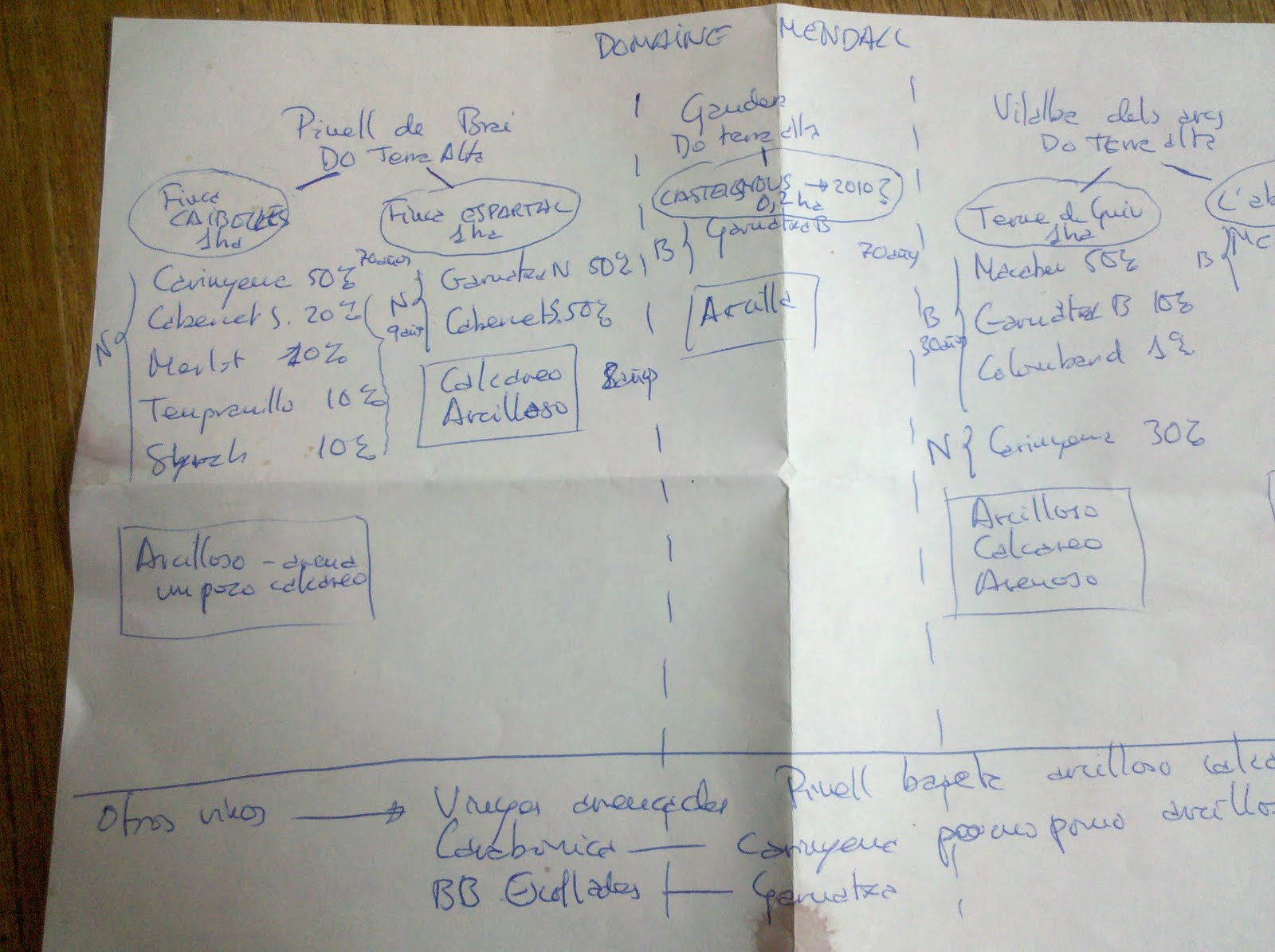
One last thing about the visit casa Laureano Serres. During the last post I did not get into his various vineyards for a reason. If you look at the sketch above, it's all spelled out for you. His friend Joan and I were joking and busting his chops a bit when he pulled this out, "Que profesional!" But the truth is, though, this sketch is far more interesting and to the point, far more indicative of someone who is involved in his winemaking on all levels, than any glossy catalogue someone could pay to produce. Better for the environment, as well.

JOE GO TO SPAIN - Part 4.2 - BRUTAL Y HEAVY, TIO


Laureano Serres, Joan Ramon Escoda and I tasted/drank 25 wines. No we did not empty 25 bottles. Yes, we did drink on occasion and did not spit every time we tasted.

Tasting a new wine (well, an interesting and tasty new wine) can be exciting. A producer line-up of largely unfamiliar wines is both exciting and a thorough education - not to mention a terrific introduction to a vineyard(s), to a certain facet of a grape varietal, perhaps to a winemaking philosophy, and of course to the winemaker overseeing the whole process. That fateful Saturday evening in Pinell de Brai served as an introduction to Laureano Serre's Mendall winery, to Joan Ramon Escoda's Celler Escoda Sanahuja and on the whole to the Spanish natural wine community.

Though I wish I had a transcript of the tasting, which was conducted primarily in castellano, with some interjections in catalan and even a smattering of english, all I have is my notes, which may be lacking in detail or accuracy; I encourage anyone who is more familiar with these wines than I am to comment and share your thoughts or feel free to correct any errors in factual information here. Sometimes, when a whole new world is introduced to you in short order, impressions are not fully recorded, facts may not always be 100% straight.

2008 Mendall Vinyes Arrancades

Peculiar wine from unusual circumstances. Mildew was rampant in Laureano's prized 100 year old macabeu vineyard. He chose not to treat it. As a result, the maturation process lasted a long time. Many leaves fell off. Finally, by late October, the grapes were picked and produced this orange-ish colored wine. Intense, mineral, funky, natty aromas and an exotic flavor profile that suggest an orange wine though there was no extended skin maceration whatsoever. A unique wine for sure.

2007 Mendall Vinyes Arrancades

Has 10% garnatxa blanca. This was done in a flor style. As Laureano did not top off his tanks, a flor somehow developed and he went with it. Just like with the mildew in the aforementioned Arrancades (sensing a theme here, yet?) Delicious wine, slightly salty and like a sous voile savagnin with more fruitiness due to the different varietal and mediterranean climate.

2006 Mendall Vinyes Arrencades

This one has a little garnatxa blanca as well as colombard. Though less expressive on the nose, it has more acid on the palate. Less mouth coating and more linear. Good.

2005 Mendall Garnatxa Blanca

If I recall correctly this wine was opened nearly a week ago? Laureano said that initially it showed very oxidatively and then dramatically opened and freshened up. There was indeed great acidity and freshness on this wine.

2005 Mendall 5 anys i 1 dia

This wine was in stainless steel tanks for five years. Untouched. 11 mg total sulphur, 11.2% alcohol, garnatxa and macabeu. Winemaking on the fringe? Yes, perhaps, but a whole lot more interesting than a bottle of over-sulphured viura, over yeasted albariño, or fruity fruity verdejo. I hope the Spain nay sayers are paying attention....

2009 Mendall L'Abeurador

Fresh fruit on the nose. Compared to the last wine this is rather straight ahead and clean. Intense fruit, a bit of hazlenut on the finish. 2 dias maceration on skins here. This may be the easiest to like of all the whites we were to taste.

2008 Mendall Terme de Guia

Macabeu, garnatxa blanca, colombard. Raisins and orchard fresh apples on the nose. Fresher flavors on the palate than the nose.

2009 Mendall Terme de Guia (1.5l)

A colder fermentation was used on this bottling. Tasty, less intense character with more acid.

2008 Mendall L'Abeurador

Back to this bottling, the 08 vintage. A warmer fermentation was employed. This tasted fresh and bright.

A wine from Laureano's friend and fellow natural winemaker Joan Ramon Escudo...

2007 Celler Escoda Sanahuja Els Bassots Conca de Barbera

Chenin Blanc. One of those wines that you can smell will assault your gums and teeth with acid (in a good way). A bit reductive, but mineral as hell and delicious. Joan described this best by calling it "un gin tonic natural." Agreed.

2009 Mendall Cara Bonica

A play on the word spanish word for carbonic maceration. Cute label of a 'cara bonica' drawn by Laureano's daughter. Rich, sweet, fresh fruit. Warm climate generosity of fruit expression, but with freshness. This is cab, merlot and cariñena with a one week carbonic maceration.

2007 Mendall Cara Bonica

A bit less fresh. Still pleasant to drink, but comparably heavy and missing the delicious primary quality of the '09.

2009 Mendall Finca Espartal

This is primarily garnatxa with a bit of cariñena, all fermented with carbonic maceration. Red fruits, skins and pits aromas of berries and plums are all here. My tasting notes after this simply read: "vino de amor."

2008 Mendall La Terme de Guia

Notes very skimpy. Here they are: "Carignan. 14%. Acid."

2007 Celler Escoda Sanahuja "La Llopetra" Conca de Barbera

PN from calcareous soils. One year in barrica (2-3 years average age). Dark fruits on the nose, a bit reductive similar to Joan's white. Acid and tart cherry/plum fruit stand out on the palate. This wine is completely sans soufre (8mg/l total sulphites). Once again, I am taken aback both by the incredible acidity and austerity of this wine, as well as by how well it takes to oak aging. Similar to Joan's chenin blanc, this is serious natural wine, well made and not for casual sipping.

2006 Naranjuez Pinot Negra Vino de Mesa

12.5% pinot noir from Granada - what? 950 meters above sea level, these grapes were harvested on September 18th. The character is intense, sauvage, and serious, with good acid. Not cheap at around $45, but interesting for sure.

2006 Celler Escoda Sanahuja Les Paradetes Conca de Barbera

50% garnacha, 25% cariñena, 25% sumoll (100 yr old). 12-13 months in oak, 25% new. Juicy, fresh berry with good acid.

2009 Vamos? Vamos!

Only 190 magnums of this collabo between Joan and Laureano were bottled. Egged on by Thierry Puzelat, the two joined forces by combining their cariñena (Laureano) with merlot and cab franc (Joan) in a fresh, delicious drink me now bottle. My TN reads, "Wow!" so it has to be good, right?

2009 Cariñena (component from Vamos? Vamos! blend)

This is the funky, berry part of the equation!

2005 Emidio Pepe Montepulciano

Closed, tough dark fruit. Sulphur, particularly notable in this natural set. I told Laureano not to open this but he just felt compelled (perhaps because he saw me eyeballing it earlier on?) It might have even been a magnum - I don't remember. Damn, infanticide....

2006 Barranco Oscuro "Rubaiyat"

Another one from Granada. Acid! Berry y muy brutal. Somehow this smelled sort of like a white wine (?) All syrah, I believe.

2004 Barranco Oscuro

No notes. I do remember this one being very tough to taste and get a read on.

Yes! "R" Blanc

Fun wine. Another flor style, dubbed yes for a one line email that importer José Pastor allegedly sent to Laureano regarding this wine: "Yes!"

2008 Mendall Mal de Sofre

This was opened a week ago. It was oxidized and showed a most unusual resemblance to Cynar, the Italian artichoke bitter. Laureano proceeded to tell me a story about Cynar in a Quentin Tarantino movie, I really do not remember more details than that.

And so ends this installment of the trip dialogue. If anyone has read through all of that nonsense and is still here then I must thank you for truly being a good sport. Tasting notes, at least those for public consumption, generally suck. That having been said, a tasting like this seemed best described in tasting note format.

Next up: The big, the boutique, the gravity fed, and the pumped/sterile filtered in Rioja.

Tuesday, May 18, 2010

JOE GO TO SPAIN - Part 4 - Yes! There is (good) natural wine in Spain


As recently as eight years ago, if you were to head to Spain in search of a natural wine scene, you would have been hard pressed to find one. It is around this time that a Catalan IT guy with a strong desire to cultivate vines and to produce wine from them started experimenting with old vine macabeu, carefully tending vineyards and making wine from them in a way that could be called hands off, no frills, and in today's context of modern, technically correct yet cookie cutter winemaking, more than slightly out of place. Nonetheless, Laureano Serres continued in his pursuit of the ideal, without a like-minded community of vignerons to consult for support or ideas about his winemaking. What began as a hobby, a two day a week pursuit, steadily grew into something ever more important and time consuming. Now Laureano is just about a full-time wine grower, producing a wide range of very tiny productions, selling in Spanish shops as well as restaurants such as michelin three star El Celler de Can Roca. He even exports some wine to France, represented by another well respected, accomplished vigneron in Thierry Puzelat.

Within those eight years, a community of eight natural winemakers has formed the Productores de Vinos Naturales. There have been two natural wine fairs in Barcelona, the most recent one a huge success, with over 1500 attendees tasting not only Spanish natural wines, but some important examples from France and Italy as well. Laureano has attended the important fairs in France and Italy, and now, unlike the early years where he gleaned information from the internet and French publications, he has a network of like-minded Spanish winemaking colleagues with whom he is in regular contact.

One of those colleagues is his good friend Joan Ramon Escoda, who also makes sans soufre (sin sulfuroso, en español) wines in the Conca de Barbera D.O. in Catalunya. Like Laureano, he is convinced that natural wines, produced from very carefully tended vineyards and with no added sulphur, can be amongst the most delicious and expressive of all. Unlike Laureano, Joan studied oenology for more than a semester, and was a paid member of the winemaking team at other wineries, including Penedes based Jean Leon (equally famous for its cabernet sauvignon as for its celebrity owner, 1950's LA restaurateur Jean Leon). He also made wine at the well respected Can Rafols dels Caus in the Garraf sub-zone of Penedes.

Joan joined us for a mega "cata" of 25 wines, some of which were made by him, others by Laureano, and a few others by another member of the PVN making wines in Granada, in some of the most highly elevated vineyards in Europe.

One crazy Catalan winemaker who produces flor wines from Macabeu (amongst other oddities), another slightly less crazy Catalan winemaker who produces one of the most mineral and acid driven Chenin Blanc based wines that you are likely to taste from anywhere, and a crazy, intrepid foreigner trying to take it all in, talk wine en Castellano, and not get too lost by the occasional Catalan rattled back and forth between the crazies. It had all the makings of an epic tasting.

Next: The tasting, as best as I can transcribe from my notes....

Friday, May 14, 2010

LO NATURAL hits España


No time for part 4 to go up this week, it seems. But I really look forward to writing it, quite possibly more than any other post I have written to date. Let me explain why.

I drove through the Catalunyan countryside, passing through pueblo after pueblo, crossing the Ebro and finally meeting one Laureano Serres at his house and winery in El Pinell de Brai. What followed was something of an introduction to the small, but fervent group of vignerons in Spain who are a part of the growing natural wine community. By now, you know the deal: careful, passionate attention in the vineyards with minimal treatments; fermentation with native yeasts, minimal to no sulphur added, and nothing else added for that matter.

Shortly after arriving, one of Laureano's best friends, Joan Ramon Escoda, another vigneron making wines in the Conca de Barbera D.O. about 30 minutes to the north, stopped by. What followed was a very extensive tasting, discussion, and sharing of thoughts and ideas about wine the likes of which I had seldom experienced. It was a heavy experience (as it turns out, 'heavy' has been appropriated into the Spanish language, pronounced with a jota, so, 'jevi'). Anyway, as I heard about the development of this tight community of 8 vignerons geared more towards natural winemaking in Spain, I learned about how it came together, Thierry Puzelat's advisory role, and most importantly I sensed the excitement and passion of these guys. It was contagious, and maybe even planted another seed somewhere in my head that perhaps I need to be out there growing vines and making wine some day.

So, that having been said, the full report will be found in part four of JOE GO TO SPAIN next week. I look forward to sharing what is undoubtedly one of the most rewarding winery visits and tastings I have yet to experience.

Wednesday, May 12, 2010

JOE GO TO SPAIN: Part 3 - Brut Nature and Chestnut aged Xarel-lo in Sant Pere de Ribes


Rafael Sala is an opinionated man. A partner of the Vega de Ribes winery, located in the Garraf national forest area just several miles from the Mediterranean, Rafael meets me in Vilafranca de Penedes to drive me to his house and few hectares of xarel-lo vineyards. It does not take long for him to notice the wire trained xarel-lo vines from the road, thus beginning a continuous commentary on all that is wrong about winemaking in the Penedes.

"These vines are all wrong. Goblets are best here, and everyone wants to train their vines en espaldera, like they do in France."

According to Rafael, this Mediterranean influenced, warm sunny region in Spain should not imitate some of its neighbors to the north, most notably Champagne and Bordeaux, likely role models for both the styles of wine made (sparkling wine and cabernet based blends, respectively) as well as for a model of proven commercial success.

"Many parts of France do not get that much sun and warmth. So it makes sense that they train the vines in a way to maximize sunlight. Here, we get plenty of sun; the vines should be low to the ground. We have the perfect climate and soils for grapes in Penedes, we have hardly any work to do at all to produce beautiful fruit. Yet people mess it up."

How do they mess it up? Rafael cites various no-no's: irrigation, trellising, harvesting unripe fruit, chaptalizing. It's a littany of practices so common in the wine world, particularly in regions such as Napa, Penedes, Bordeaux and Champagne, all large regions with a high capacity of production, captive markets and large commercial opportunities. On the contrary, Rafael's 60 year old xarel-lo vines are all en vaso, Spanish for goblet or bush vines. This fruit will go into the Vega de Ribes Clar de Castenyar Xarel-lo. The vineyards were still verdant, with a natural cover of indigenous plants, weeds and herbs growing everywhere. Rafael mentioned that he will cut these back a bit, but that there is no need to do much else. A plant knows exactly what it needs to do to survive, Rafael points out, so why intervene during the growing season?


Once the fruit is mature and ready to be harvested, Rafael believes in bringing the grapes into the cellar well chilled, and maintaining these cold temperatures throughout the fermentation process. Fermentation takes place in used barrels of chestnut coming from Galician forests, and then the wine is cold stabilized in stainless steel before resting a bit longer and bottling. Given the organic bent of his viticulture and his positions on wine, I expected Rafael to be a big fan of natural wines, and sympathetic to some of these positions. Surprisingly, though, he does not seem too loyal to these concepts. Regarding yeast, he says that they experiment with both cultivated and indigenous fermentations, and do not notice much of a difference between the two. And as far as sulphur, he reckons that there are 15 mg/l free sulphites, perhaps 60 mg/l total - perhaps a bit lower than the norm but too high to be amongst the "vin naturel" set.


We then go inside his house to taste a few vintages of the Clar de Castenyer. 2006 is still a pale straw yellow, with almond paste, golden delicious apples and white fruit aromas leading to a palate showing just a trace of an oxidative quality. Fresh stone fruit flavors are more prominent than the nutty oxidative ones. 2007 is more intense, with ripe fruit, some red fruit sneaking in. Though it tastes riper than it's 12.5% alcohol, the flavors are strong though nicely balanced. 2008 seems to lie somewhere between the 2006 and 2007, showing qualities of both. So yes, good xarel-lo, from older vines which are allowed to produce fully mature fruit, appears to age nicely.

After this mini vertical, Rafael, his wife and I head to his partner Enric's house, a structure dating back to the 1400's, with its most recent major renovation taking place in the early 19th century. Here there are some additional xarel-lo vines (curiously, trelised) which go into the Ancestrale Brut, as well as sauvignon blanc, sumoll and a rare type of malvasia known as malvasia de sitges, which they believe came from original malvasia cuttings brought over from Turkey in the middle ages. These grapes go into their methode ancestrale sparkling malvasia.

We head to Cal Xim for a typical Catalan lunch. Pan amb tomaquet, marinated anchovies and a terrific assortment of olives open the meal. We then dig into a tortilla, followed by simply grilled fish, turbot in my case. Crisp skin, moist flesh inside, and nothing other than some capers, lemon and sea salt on top made this a welcome, fresh, satisfying entree. In the land of chorizo, jamón iberico, tortillas, flavorless bread and atún topped iceberg lettuce salads, the
freshness and vibrancy of this meal was well timed and thoroughly enjoyed. Throughout the meal, Rafael was keen to show his Ancestrale sparkling wines. Both of these are fermented in the methode ancestrale, though the secondary fermentation finishes in bottle. Unlike what he dislikes in his cava, there is no chaptalization, no liqueur de tirage, no liquer de expedition: these are true brut nature wines. Though given the ripeness of the fruit, they are really generous and do not taste nearly as dry as many other Brut nature cavas out there. Both the brut and brut rosé wines are quite good. The rosé in particular, with the intensely flavored, spicy, indigenous sumoll grape contributing to the flavor profile, is very interesting. Rafael likes to boast that the technical director of Freixenet is a huge fan of his sparkling wines, especially the sparkling Malvasia. In his mind, he's got something up his sleeve, a sparkler that is much tastier, more natural, and healthier than anything else being produced elsewhere in Penedes.


"If you're going to do something," says Rafael, the former technology consultant, with a bit of a glimmer in his eyes and a friendly competitive air, "do it well."

*CORRECTION: Rafael has informed me that the TOTAL sulphites in his wines are typically around 15 mg. The free sulphites are 0.

Up next: Further south and inland in Catalunya, vigneron and natural wine proponent Laureano Serres Montagut, of Bodegas Mendall, complains of high sulphur in Rafael's xarel-lo, claims that drinking txakoli might kill you.

Monday, May 10, 2010

JOE GO TO SPAIN: Part 1 - How does a food and wine trade mission work?


I pondered this very question in the time leading up to my recent trip to Spain. As well as several others: How many stateside colleagues would be present? How many producers would I be meeting with, and would any of them have decent product to sell? Who pays for all of this? Besides the round trip ticket and hotel accomodations for 4 nights, would the time spent be worthwhile?

As it turns out, we were 10 Americans, a few importer reps, a few distributor reps, and a few retailers, spanning the continental United States from Philadelphia to Seattle. I met with 6 producers a day for two days, inside a room at the Chamber of Commerce in Terrassa. Many of us met with the same producers, sort of what I imagine speed dating to be like except the participants are wine producers/export directors/brokers on one hand and importers/distributor reps and retailers on the other. And instead of 5 minutes we generally had an hour per appointment.

From what I understand, such missions are paid for by the local chamber with some significant subsidies from the regional (in this case the Catalunyan) government as well as the EU. If I heard correctly, each winery representative needs to pay 80 euros to participate, along with 50 euros for each meeting. So to schedule a full day's worth of meetings would run about 380 euros or approximately $500 US. Not exactly cheap, but I suppose worth the cost if a good importer is found and a lasting business relationship forged.

And the wines? If you're thinking to yourself, that if you need to go and spend money to find yourself an importer, your wines probably are not very good or interesting, then in most cases you would be correct. That having been said, there is always a need for commercial wines, available in commercial quantities, which are drinkable and relatively inexpensive. I came here seeking cava, and now I have at least a couple of possibilities to work with. Additionally, there were some hand made wines, produced in smaller quantities, which were quite good. One producer boasted some terrific pansal blanca (a variation of the xarel-lo grape grown in the Alella D.O, north of Barcelona.) Usually xarel-lo is picked green and way underripe for cava and even white wine production, though this wine was round, harmonious, mouthfilling and full of delicious fruit, with a silken texture. It reminded me of Chenin. This same producer made a red wine from an indigenous Catalunyan varietal called sumoll. It was intensely dark fruited and wild, while still retaining its acidity in the warm Mediterranean climate. Might be a good bet for production in California.

Also, a Priorat producer neighboring Clos Erasmus and Val Llach had wines to sell that were actually priced reasonably, not overoaked, and produced from organically cultivated grapes.

So yes, some new discoveries were made, and the time spent in Terrassa was worthwhile.

Next up: Cava history and cava production at Raventos i Blanc.

Wednesday, April 28, 2010

Terrassa, Spain


Here I am, at the computer of the Hotel Vapor Gran, the "Great Vapor," the very best business hotel in Terrassa, Spain. As I may have mentioned earlier, La Cambra de Terrassa is generously supporting this business wine trip junket. Today, after a heartfelt, teleprompter style (just with typed remarks on paper subbing for the screen) heavily accented reading of opening remarks from one of the Chamber´s veeps, we were off to meet with many different wine producers representing the Penedes, Terra Alta and Costers del Segre regions. Filtered, heavily sulphured, correct yet anonymous, large (make that, HUGE) production wines were poured, one after the next. There were a few great values. Though I will yet again lose wine cool points for saying so, some of my favorites were the cheapest: wines made in very large quantities from primarily garnacha (for the reds) and garnacha blanca (white) grapes. Wines fermented with selected yeasts and lightly filtered prior to bottling. For just a few euros ex-cellar they are well worth the cost. Also, the young enologist who presented these wines was very well informed about the wine´s production process. No bullshit, just honest answers and explanations. Might see these in a K&L store or website at some point.

Apart from the day´s meetings and the disappointing, lackluster performance that led to the Barça defeat at the hands of the Milanese, the clear highlight so far has been linking up with Gabriella Opaz of Catavino fame. She lives in Terrassa and told me all about it: the city´s construction boom over the last 4 years, the discovery of dinosaur bones and ensuing delay of the construction of the Metro station, and the annual jazz fest that is Spain´s best. Definitely owe a huge "gracias" to Gabriella for meeting me and adding such valuable local perspective my first night staying in Terrassa.

Tomorrow, more junket. Friday, Raventos i Blanc. Saturday, natural wines at Vega de Ribes and Mendall. Sunday, hanging out with the Peciñas in San Vicente de la Sonsierra, Rioja. Then more Rioja next week. Just so you know what to expect in the days ahead, or what to skip out on if you prefer when I write about non-Spanish stuff.

Hasta pronto, queridos lectores....

Friday, April 16, 2010

Jay Miller and I will both be in Rioja the same week


One of my favorite wine traditionalists from anywhere, María José Lopez de Heredia, recently informed me at a tasting of her family's wines at Heart in La Mission, San Francisco, that The Wine Advocate's own Jay Miller will be in Rioja around the same time I will be. Might our paths cross? Is there a Baltimore wine reunion in the works here? I'm not sure what to make of this other than the fact that the wine industry is so fucking small, a fact proven to me over and over again the past six and a half years I have been involved in selling wine. In fact, there was a time when I used to sell wine to Jay Miller when he was part owner of a Baltimore wine shop.

It's a small world.

Tuesday, April 6, 2010

Spain in 3 weeks


Press junkets for wine bloggers are popular these days. Whether it's debating the merits of typicity vs oak influenced, post-modern homogeneity in the Piemonte, or reporting on wineries, abalone farms and other attractions in Paso Robles, there is most assuredly a junket for any blogger with just a little bit of hustle and some writing ability.

Now, I do not claim to be hustling or writing particularly well of late. Fortunately, however, I was approached by the US-Spain Chamber of Commerce with a junket proposal through my daytime gig as a Spanish wine buyer and will be heading to Spain - to the city of Terrassa, specifically. Throughout the week, I will be tasting and meeting with various Catalunyan producers, likely to be mainly in the Penedes D.O. The idea is that I find something I like, of some perceived commercial value, that I can sell to my customers. The good old direct importation model of selling wine. While in Terrassa I am very excited to be meeting up with Gabriella Opaz, who is one half of the husband-wife team at catavino. They have done a great job not only with their Iberian focused wine blog, but with uniting wine bloggers throughout Europe. Who knows, maybe she will teach me how to blog better.

In addition to seeking some wines that are honest, well-made and priced to move in large quantities, I will certainly be visiting a few producers of wine on a smaller, more human scale, making more natural wines. I have a few addresses I am planning to visit but would love to hear any thoughts on what may fit into this category. Oh, as a reminder small production and organic does not necessarily equate to natural.

After the week is up, I will stay several extra days to explore Rioja. With the exception of one huge, historical bodega whose wines I quite like, I will be focusing on smaller producers. Once again, any ideas are welcome.

Ideally, I will be reporting from the ground in Spain, which should hopefully provide some entertainment, with perhaps a bit of education for good measure.

Edutainment for the massses.

Wednesday, March 10, 2010

Site vs Elevage

A view down to the barrel rom at Cune's Viña Real winery in Laguardia, Rioja Alavesa

I attended a seminar this morning titled, "Tempranillo: Site vs Elevage." It preceded a De Maison Selections trade tasting, and was conducted by the erudite, always interesting Andre Tamers. You may recall that he was one of the people I had briefly interviewed last year for a piece on the state of Spanish wine. Without getting into too much detail, Andre pointed out that Rioja was traditionally based on the premise of house style, a la Bordeaux, or even more so, Champagne. Just as in Champagne, in Rioja there are some larger companies who both grow their own grapes as well as purchase fruit from all over the D.O. Then, different bodegas have different methods of vinification and aging; traditionally in a slightly oxidative manner involving extended aging in American oak, a few rackings a year, and bottle aging. In Andre's view, this type of blending and aging process creates wines that are overly oxidized and lack individual personality. OK, he did not explicitly say that so as to let attendees make up their own minds, but reading between the lines (as well as tasting through his Rioja portfolio) that is most likely where Andre stands.

Perhaps, according to Andre, the future of Rioja lies not in a bodega's skill at blending fruit from different sites, even different sub-zones separated by many kilometers (as has been the traditional model) but rather in estate bottled, village and vineyard designated wines. As Andre said, "Gevrey doesn't taste like Chambolle. " That is obviously due to differences in soil types, climate, aspect and a whole host of other factors - in short, terroir, or "terruño" in Spanish.

So the point was to show 3 flights of Rioja of various ages (joven, crianza, and reserva) based on which villages the wines were from, and to try to taste the different character of each site. Thing is, though, it was very difficult to do this given, you guessed it, the wine's dramatically different elevage. Was the 2005 Viña Real Crianza's spicy, strawberry fruit characteristic of Tempranillo from Laguardia, or of fruit that is perhaps picked a bit earlier than is fashionable these days? And the sweet, black cherry and fruitcake flavors of the 2006 Luberri "Biga" Crianza were because the wine's fruit hails from Elciego, or due to the French oak, some of it new, and possibly other methods in the winery? Maybe the grapes were picked later and riper? There was at least one surprise as well, at least in terms of fruit sourcing for the 2005 Bodegas Muga Reserva. Andre had picked it to show what a Tempranillo based wine from Haro tastes like, though it turns out that one of his producers disputed the grapes exclusive Haro, Rioja Alta provenance, as he regularly sees the Muga truck in villages in Rioja Alavesa.

As with any academic learning experience, far more questions were generated than answers. Some questions I pondered after the tasting:

Is extended aging in American oak, when well employed with good quality fruit, an intrinsic part of Rioja's terruño? Is that a good thing?
Is it realistic for Rioja, which lacks the tradition of village and vineyard branded wines practiced for centuries in Burgundy, to try to re-brand itself in this way?
Why is Rioja either traditional or modern?
Is anyone experimenting with different sizes of oak for aging and fermenting, larger foudres for example? Or perhaps new barrels without any toast?
Is 100% tempranillo based wine from Rioja the best vehicle to express the region's diverse terruño, and is it the best path to take for the region's many crianza and reserva bottlings?
What constitutes good, reasonable and attentive farming and viticultural practice in Rioja versus elsewhere?

Thank you to Andre Tamers of De Maison Selections, as well as his staff and the folks from Estate Wines for putting this together. In particular to Andre, whose knowledge of Spanish wine country, paired with a real curiosity and sense of humility, made for a terrific seminar which emphasized learning about a region over merely pushing product.

Wednesday, July 8, 2009

In Search of Traditional and Natural Spanish Wines in Spain

This is part of Cory Cartwright's 31 Days of Natural Wine Series on his blog, Saignee. Follow it here.

Old fermentation vats at R. Lopez de Heredia Viña Tondonia, amongst the most successful producers and marketers of traditional Spanish wine

For a country that boasts more land under vine than any other, with a variety of terroirs, climates, winemaking traditions and styles that is only surpassed by France and Italy, Spain has a long way to go in the natural wine world.

The definition of natural wine has generally come to encompass organic or biodynamic vine cultivation in the vineyard, fermentation with native yeasts, minimal intervention in the cellar, and significantly lower doses of sulphur at all stages of the winemaking process. Another classification of this sort of farming and winemaking could be 'traditional.' In other words, the way that conscientous, quality oriented winemakers made their wine before the advent of fertilizers, herbicides and pesticides in the second half of the 20th century, and prior to the emergence of the new French oak barrique, lab made yeasts and assorted heavy handed cellar methods.

If natural wine means wine made traditionally with the fruit of well tended vines, why would Spain - a country steeped in wine tradition and covered (to the tune of 1.16 million hectares) with vines - be lagging far behind Italy and France in the production of natural wines?

"The Spanish are very attracted by a modern attitude towards winemaking and keeping up with the trends as they perceive them in the world," says Spanish wine importer Andre Tamers of De Maison Imports, a company which focuses on small production, traditional, natural Spanish wines.

"They have been very influenced by wine critics and styles that are pervasive today as a way to differentiate themselves from their past."

That past, up until fifteen or so years ago, usually involved picking grapes that were not super-ripe, and aging for longer periods of time in larger vessels, often times made of American oak, or perhaps concrete. Some of the wines which resulted from this practice tasted oaky and dried out, lacking vibrancy and fruit. Often times they were also oxidized. Many of these wines, however, were distinctive and delicious, as Santo Domingo and New York based wine blogger Manuel Camblor recalls, "[the late 80's-early '90s] was a time when five bucks could still buy you a wonderful bottle, if you had your head on straight."

Of today's similarly value oriented bottles from Spain, Camblor is far less enthusiastic, decrying most of them as 'homogenized and globalist' with 'zero soul.'

'Zero soul' wines sure are popular with the vast majority of discerning Spanish wine critics in the US, abroad and even in Spain. There are countless examples which score 90-92 pts on a 100 pt scale, and cost a mere $15 or less. While those who value consumer reports may be elated, others with more drinking experience, or even those who are relatively new to Spanish wine and have tasted the real thing, tend to look for authenticity.

Bodegas R. Lopez de Heredia Viña Tondonia, in Rioja, is that rare Spanish wine that appeals to a cross section of new Spanish wine drinkers, seasoned Spanish wine afficionados and even the hypercritical, generally French leaning tastes of natural wine fans. They farm organically, harvest by hand, allow fermentation to take place naturally in huge, very old American oak vats, and in many respects make wine in a manner similar to how it was made in the early years of the bodega in the late 19th century. As staunchly traditional as the wines are, Maria José Lopez de Heredia is far from critical of more modern efforts being made elsewhere in Rioja and throughout Spain.

"Spanish palates have evolved with the progressive integration in the European Union," says Lopez de Heredia, "and have become more international in the acceptance of styles and flavors. Also all palates get adapted to the products that exist on offer."

So are Spanish palates becoming more international, appreciating the same sorts of richer, heavier, higher alcohol wines which have sold so well in the US? Not necessarily so, according to Andre Tamers:

"Spain is still a very classic wine drinking nation and many of the wines that show up on our shores are expressly for a foreign market very similar to the way Sherry was sold two hundred years ago to the British (sweetened)."

Another importer who has been seeking out authentic, traditional Spanish wines is Jose Pastor, who imports properties such as Señorio de P. Pecina in Rioja and the unusual, but rewarding Monastrell based wines of Primitivo Quiles outside of Alicante.

"I would say that it is getting harder to find honest [Spanish] producers," says Pastor.

Neatly summing up the current lack of conviction plaguing Spanish winemakers, as well as importers and retailers, Pastor observes:

"The problem that I see here, is that we are trying too hard to please other people when we should first learn how to please ourselves."

Monday, March 16, 2009

Contigo: Very good Spanish tapas in SF


This past Friday, I had the pleasure of eating at an authentic, Catalan inspired tapas restaurant which recently opened up in Noe Valley. Contigo is the vision of Brett Emerson, who apparently had been in the process of opening his restaurant for the better part of two and a half years (read more about the struggle on his blog here). Yes, between financing, build out, licensing, staffing and many other considerations, opening up a restaurant has the potential of testing even the most patient of business owners. Well I'm glad that Emerson and his business partner (front of house manager and girlfriend Elan Drucker) perservered. The fact that the space is as green as it is, from building materials all the way up to choice of a printer for their business cards, is an added bonus. As far as first rate regional food experiences go, Contigo is a great addition to any San Francisco resident's list of go to places in town. And if you're out of town, on the prowl for tapas, Contigo should be at the top of your short list. For the New York tapas fans, think Casa Mono or Tia Pol. Otherwise, the only other comparisons would be the more contemporary (but not overly so with regard to foams, quotations and precious plating) tapas bars in Spain.

What follows is not a proper restaurant review, but rather some captioned photographs of the food. I'm sure that I'll be back soon to further explore the menu and enjoy more of what's on offer. If you're in the area, I suggest that you do the same. In fact, maybe an SF food and wine blogging (readers and bloggers alike) community dinner is in order.


Fried skate with pan fried baby artichokes


Roasted chicken


Coca (Catalan flatbread) with house made Basque style chorizo and wilted radicchio

Tortilla española with mushrooms

mixed chicory salad

croquetas de buey (deep fried balls of braised brisket, served with arugula and a lemon wedge - great flavor and textures: crisp, juicy, smoky, earthy, bright)


Setas a la plancha (wild mushrooms with parsley pesto)


Iowa's finest: La Querccia prosciutto


Bread served with fruity, mellow, arbequina olive oil


A humble '04 Montsant blend of Garnacha, Cariñena, and one or two international varietals from Celler El Masroig called 'Castell de les Pinyeres.' Sturdy, fruity and well liked by our table.

Thursday, January 22, 2009

SPANISH WINE, gateway to the old world, bridge to elsewhere (anywhere else) in Europe?


Pop Quiz 1 - After you first got into wine, after you learned your cab from your pinot noir and chardonnay from your sauvignon blanc, which country's wine's did you check out next?

Pop Quiz 2 - You are a wine geek. You love nearly anything 'naturally' made, especially if it is French. A.) Explain your Francophile tendencies. B.) Extra credit. You enjoy good sherry and Rioja from Lopez de Heredia. What do you know about Spain's other wines? And how does your preference for honest, low alcohol, high acid French wines inform your exploration into other types of wine, mainly those from Spain?

Monday, December 1, 2008

Thanksgiving recap

We pulled it off. 14 people, a first time heritage turkey cooking experience, Spanish vs French wines. Somehow it all worked. We started with 2004 Francois Pinon Vouvray Brut (1.5l), progressed to some whites, worked our way through cru beaujolais and Rioja, and finished with a 1990 Gordon & McPhail Glen Grant bottling. Some things I learned:

- Truffled may not be the only way to do Thanksgiving mashed potatoes, but it's surely the only way I plan on doing it in the future. Here's a recipe for 15 (with some leftover): peel, cut and boil 8 lb of russets for 20 minutes, drain, mash with a pint of half-and-half, a stick of butter, 2 tbsp white truffle oil, salt, pepper. Transfer into a baking dish, grate some parmeggiano on top, throw under the broiler to make a crust, take out of oven and douse with more truffle oil. A crowd pleaser, and incredibly easy.

- Thanksgiving is a white wine affair. The right cru beaujolais may do the trick, but not as well as the right whites.

- Spanish wines can work great. True, I'm a fan and write them up fairly often here, but the right Spanish wines work every bit as well as anything else for Thanksgiving. In fact, the '07 Carballal Sete Cepas Rias Baixas, with its terrific phenolic ripeness, moderate alcohol and bright acidity, was the best wine with dinner. Rich enough for the meatier than usual heritage bird, very receptive to the earthy savor of mushroom stuffing, and somehow equipped to even handle the sweet-tangy cranberry sauce. As far as reds, I wish I had had another bottle of 1999 Campillo Rioja Reserva. Why drink CA pinot (or moderately priced Burgundy, for that matter) when you could have this? It's a perfect compromise between softer, plumper new world fruit, and more old world acidity, terroir and savor. Perfectly balanced, traditionally styled Rioja with a bit of bottle age.

- Just about everyone loves the Beach Boys. As is usually the case, Dad was happy to be the itunes DJ, striking a chord with our Swiss guests when he played California Girls ("Udo, that's what was playing when we first met in Paris in 1968!") A few of us then reminisced about the video for the version of this tune which my generation perhaps knows a bit better:

Tuesday, November 18, 2008

Old Rioja, Old School


A few weeks ago, one of my co-workers paged me overhead. I picked up the phone, returned the call, and was told, “Joe, we’ve got some wines to taste. Trust me, it’ll be worth your time.” Having tasted plenty of super slick, same old, cookie cutter, oaky -fruity wines with this particular co-worker, I am confident that he has a pretty good sense of my palate and what I like. So on this particular day, we were to taste older vintages of Rioja and even a few middle age Ribera del Dueros. Nothing too fancy, no big names, but that in and of itself was exciting. After all, as many Spanish wines are now exported to the US, most of these are made with the US consumer in mind, and in fact many of the most popular are essentially wines sold exclusively outside of Spain. So whenever I have the opportunity to taste something of the old guard, or a winery’s library wines which were made in the older style (lighter in mouth, higher in acidity, subtler and more layered in its flavors), I jump.

It’s also always exciting to discover traditional Rioja which is not made by La Rioja Alta, Lopez de Heredia, or one of the much larger, more venerable bodegas.

Don’t know too much about these bodegas, but here are some tasting notes.

1982 Suso Rioja Gran Reserva

Tobacco and sweet red cherries on the nose. A touch of marzipan as well. Nice, ripe, red fruit, with a bloody iron element as well. Fully mature. Not bad.

1985 Izadi Gran Reserva

OK, so all of these are not no names. Izadi is a well regarded bodega in Rioja, nowadays leaning new school, but still making wines that sometimes show decent balance and deep, intense, pure fruit. This particular bottle, from the excellent ’85 vintage, shows truffle, sweet cocoa powder and braised brisket on the nose. Lots of bass tones on the palate, darker fruits that really build up and expand on the palate. More cocoa. Very tasty mature Rioja here.

1991 Señorio de Ulia Rioja Gran Rerserva

My co-worker thought this a bit tired, but I heartily disagree. Very savory, spicy and meaty aromas led to a similarly savory, spicy and meaty palate. Good acidity and terrific balance.

1995 Señorio de Ulia Reserva

Another winner from this bodega. Similar sense of balance, spicy savor, and strong acid backbone. Persistent as well.

1999 Abadia de San Quince Ribera del Duero Crianza
Shy dark fruit on the nose, but a lot more interesting on the palate. Black currants, minerals, very tasty. I’m a firm believer that1999 is an underrated vintage in Rioja, could it be the same in Ribera as well?

1999 Penalosa Ribera del Duero Crianza

Not as tasty as the wine above. More baked, not so fresh, even a touch lactic, aromas. Clearly dying on the palate.

It's always an education tasting more mature vintages. Old wines, bring 'em on, that's what I say....

Friday, October 31, 2008

Further explorations in New York City; dinner at Tia Pol


New York City is one of those rare places on this earth that I will never tire of visiting. While I have never lived there, outside of a few months one summer while in college, I have come to take a certain ownership and pride in this most American of cities. My visits there have taken me from the brunch spots on the good old upper west side (them's my people, after all), to the foodie and hipster strongholds of the east village and Williamsburg, back up to mid-town during the uber consumerist holiday shopping season, further uptown to the contrasting botanical gardens and cement in the Bronx. Down to neighborhoods in various states of gentrification in Brooklyn. From Fort Greene to Greenpoint, Queensbridge to Jamaica, Queens, all the way east to Sir Coxsone Dodd's record shop in East New York, Brooklyn. I've seen a lot, and still feel like I haven't even scratched the surface of the diversity the city has to offer.

This time around, the trip was short, sweet, and centered on the island of Manhattan. A few hours viewing early near eastern and Chinese art at the Met, followed by a stroll down 5th Ave to my mid-town hotel, and another walk over to Chelsea to meet my friend Cam for drinks and tapas at Tia Pol. Co-Owners Heather Belz and Mani Dawes (daughter of noted Spanish wine and food expert Gerry Dawes, as well as owner of the all Spanish wine boutique Tinto Fino) have put together quite an authentic and convincing list of tapas, complemented by a solid all Spanish wine list, with highlights including older 80's vintages of La Rioja Alta's reservas and gran reservas. As it was not to be a splurge type of night, I chose to start off with another highlight of Tia Pol: their sherry list. If you like sherry, or are just curious about tasting a variety of some of the best examples, then you need to head to Tia Pol. Three finos, two manzanilla pasadas (longer aged, richer manzanilla), two manzanillas, amontillados, three (yes, 3!) types of palo cortado. I started with the Maestro Sierra fino, which I have heard a lot about and had not yet tasted. I immediately noticed the extra richness and texture from the older solera the bodega boasts. Probably amongst the best fino sherries I have tasted, full of extra broad mid-palate fruit, complexity and savor, though a bit lacking in the salty tang you might expect. With the tapas, we ordered a bottle of '97 LdH Vina Tondonia Rosado. It's in a great place right now, very bright and red fruited, showing the subtle american oak spice tones which define the best Rioja. While I have gotten used to the taste of wines with an extended aging in older oak, Cam commented on the 'sherry like' flavors she tasted. She loved the wine, but noted the oxidation more than I did. The wine paired well enough with everything, though it seems to have more of an affinity for foods of land rather than those of the sea, at least of the types we were eating. Some of the standout tapas included txipirones en su tinta (meaty, savory squid cooked in their own ink) montaditos de crema de habitas con beyos(little open-faced sandwiches with a spread of fava bean puree and beyos cheese) and navajas y almejas(cockles and razor clams, simmered in a white wine, fish stock and garlic flavored broth).

It was a short, but fun and rewarding trip. I encourage anyone spending time in New York to visit Tia Pol (again, they're in Chelsea, on 205 10th ave betw 22nd + 23rd), as well as to explore part of the city you have not yet visited. In The City, that's the only way to roll.